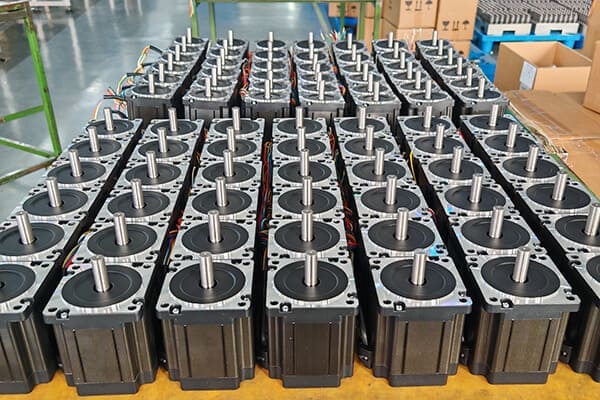
Brushless DC (BLDC) motors have become one of the most important motion control technologies in modern automation, robotics, medical equipment, electric vehicles, drones, CNC machines, and industrial systems. Compared with conventional brushed motors, BLDC motors offer higher efficiency, longer lifespan, lower maintenance, and precise speed control.
This comprehensive guide explains everything you need to know about BLDC motors and BLDC motor controllers, including their structure, commutation methods, control algorithms, performance parameters, applications, advantages, disadvantages, and how to select the right motor for your project.
What Is a BLDC Motor?
A Brushless DC Motor (BLDC motor) is a synchronous electric motor powered by DC voltage and electronically commutated through a motor controller instead of mechanical brushes.
Unlike traditional brushed motors that use carbon brushes and commutators, BLDC motors employ permanent magnets on the rotor and windings on the stator. Electronic switching controls current flow to generate rotating magnetic fields that drive the rotor.
Key Features of BLDC Motors
High efficiency (85–95%)
Long service life
Low maintenance
High power density
Quiet operation
Precise speed control
Excellent torque characteristics
Wide speed range
Structure and Types of BLDC Motors
A BLDC motor consists of several key components:
Rotor
The rotor contains permanent magnets, usually:
Neodymium magnets
Ferrite magnets
These magnets generate magnetic fields that interact with the stator windings.
Stator
The stator consists of laminated steel cores and copper windings arranged into three phases.
Position Sensor
Rotor position feedback is achieved through:
Hall sensors
Encoders
Sensorless back-EMF detection
Motor Controller
The controller performs electronic commutation and regulates:
As a professional brushless dc motor manufacturer with 13 years in china, Jkongmotor offer various bldc motors with customized requirements, including 33 42 57 60 80 86 110 130mm, additionally, gearboxes, brakes, encoders, brushless motor drivers and integrated drivers are optional.
Wires
Cover
Fan
Shaft
Integrated Driver
Brake
Gearbox
Out Rotor
Coreless Dc
Driver
Motor Control and Commutation Methods
Electronic commutation determines motor performance.
Block Commutation (Trapezoidal Control)
Block commutation energizes phases every 60 degrees.
Advantages
Simple implementation
Low cost
High starting torque
Disadvantages
Torque ripple
Noise and vibration
Typical applications:
Pumps
Fans
Compressors
Sine Wave Commutation
Current follows sinusoidal waveforms.
Benefits
Smoother operation
Lower noise
Reduced vibration
Applications:
Medical equipment
Precision instruments
Field-Oriented Control (FOC)
Field-Oriented Control (FOC) is the most advanced BLDC control technology.
Advantages
Precise torque control
High efficiency
Fast dynamic response
Ultra-low noise
Wide speed range
Applications:
AGVs
Robotics
Servo systems
Electric vehicles
CNC machines
Sensorless Control
Sensorless BLDC motors eliminate Hall sensors and use back-EMF estimation.
Benefits
Lower cost
Improved reliability
Simplified wiring
Applications:
Fans
Pumps
Home appliances
Important BLDC Motor Parameters
When selecting a BLDC motor, understanding these specifications is essential.
Brushless DC (BLDC) motors are widely used in industrial automation, medical equipment, power tools, electric vehicles, drones, and household appliances because of their high efficiency and long service life. However, like any technology, BLDC motors have both advantages and limitations.
Advantages of BLDC Motors
1. High Efficiency
BLDC motors typically achieve 85%–95% efficiency, which is significantly higher than traditional brushed DC motors. Since there are no brushes creating friction, less energy is wasted as heat.
Benefits:
Lower power consumption
Reduced operating costs
Improved battery life in portable devices
2. Long Service Life
Because there are no brushes or commutators to wear out, BLDC motors require minimal maintenance and can operate for tens of thousands of hours.
Benefits:
Lower maintenance costs
Greater reliability
Reduced downtime
3. High Speed and Excellent Speed Control
Electronic commutation allows precise speed regulation and smooth operation across a wide speed range.
Applications:
Laboratory stirrers
Pumps and fans
CNC machines
AGVs and robotics
4. High Torque-to-Weight Ratio
BLDC motors provide high torque output while maintaining a compact size and lightweight design.
Advantages:
Space-saving installation
Improved power density
Suitable for portable and compact equipment
5. Low Noise and Smooth Operation
Without brushes generating sparks and friction, BLDC motors operate quietly and with minimal vibration.
Ideal for:
Medical equipment
Laboratory instruments
Home appliances
Office automation devices
6. No Sparking and Better Safety
Electronic commutation eliminates brush sparks, making BLDC motors suitable for sensitive or hazardous environments.
Applications include:
Medical devices
Battery-powered tools
Ventilation systems
Chemical processing equipment
7. Better Heat Dissipation
The windings are located on the stator rather than the rotor, allowing heat to dissipate more effectively.
Benefits:
Higher continuous output power
Improved thermal stability
Longer motor lifespan
8. Precise Position and Motion Control
Combined with Hall sensors or encoders, BLDC motors offer excellent accuracy and dynamic response.
Widely used in:
Servo systems
Robotics
Automated conveyors
Packaging machinery
Disadvantages of BLDC Motors
1. Higher Initial Cost
BLDC motors require electronic controllers and permanent magnets, resulting in a higher upfront cost than brushed DC motors.
Challenges:
Increased system investment
More expensive components
However, lower maintenance and higher efficiency often offset the initial expense over time.
2. a higher upfront cost than brushed DC motors.
Challenges:
Increased system investment
More expensive components
However, lower maintenance and higher efficiency often offset the initial expense over time.
2. More Complex Control System
Unlike brushed motors, BLDC motors need electronic commutation and dedicated drivers.
Requirements:
Motor controller
Hall sensors or sensorless algorithms
More sophisticated control software
This increases design complexity for OEM manufacturers.
3. Dependence on Electronic Controllers
A BLDC motor cannot operate directly from a DC power supply without a controller.
Potential issues:
Controller failure can stop the entire system.
Additional wiring and electronics are required.
System integration is more complex.
4. Permanent Magnet Cost and Supply
Most BLDC motors use rare-earth magnets such as neodymium, which can be expensive and subject to market price fluctuations.
Impact:
Higher manufacturing costs
Supply chain sensitivity
5. Risk of Magnet Demagnetization
Excessive temperatures or improper operating conditions may reduce magnet strength over time.
Solution:
Proper thermal management
High-quality magnet materials
Adequate cooling design
6. Electromagnetic Interference (EMI)
The electronic switching inside BLDC controllers can generate electromagnetic noise.
Mitigation methods:
Shielded cables
EMI filters
Proper PCB design
Advantages and Disadvantages Comparison
Feature
BLDC Motor Advantages
BLDC Motor Disadvantages
Efficiency
85–95% efficiency
Higher initial cost
Maintenance
Almost maintenance-free
Requires electronic controller
Lifespan
Long service life
More complex system design
Speed Control
Excellent precision
Additional sensors may be required
Noise
Quiet operation
Controller generates EMI
Size
Compact and lightweight
Permanent magnets increase cost
Reliability
No brush wear
Electronics add complexity
Safety
No sparking
Sensitive to controller failures
Conclusion
BLDC motors offer high efficiency, long life, low maintenance, quiet operation, and precise control, making them an excellent choice for modern automation and motion-control applications. Although they involve higher initial costs and require sophisticated electronic controllers, their superior performance and lower lifetime operating costs make them increasingly popular across industries. For OEM and industrial applications, customized BLDC motor solutions with integrated drivers, gearboxes, and encoders can further enhance system efficiency and reliability.
Do BLDC Motors Use AC?
Although called DC motors, BLDC motors actually operate with three-phase AC currents generated by the controller.
Power Flow
DC Source →
BLDC Controller →
Three-Phase AC Waveforms →
Motor Rotation
Therefore, BLDC motors are electronically commutated AC machines powered from DC sources.
Do BLDC Motors Need a Controller?
Yes.
A BLDC motor cannot self-commutate.
The controller performs:
Phase switching
Speed regulation
Torque control
Direction control
Current limiting
Over-voltage protection
Over-current protection
Without a controller, the motor cannot rotate properly.
Which Is Better: BLDC or AC Motor?
Comparison
BLDC Motor
AC Induction Motor
Efficiency
Higher
Moderate
Speed Control
Excellent
Good
Maintenance
Low
Low
Torque Density
High
Moderate
Noise
Low
Moderate
Cost
Higher
Lower
Controller Requirement
Required
Optional
BLDC Motors Are Ideal For
Medical devices
Robotics
AGVs
Electric vehicles
Laboratory automation
AC Motors Are Suitable For
Pumps
Fans
Heavy industrial loads
How Long Do BLDC Motors Last?
The lifespan of a BLDC motor depends on:
Bearing quality
Temperature
Load conditions
Controller quality
Environment
Typical operating life:
Bearings
20,000–40,000 hours
High-End Industrial BLDC Motors
50,000–100,000 hours
Because there are no brushes, bearing wear becomes the primary life-limiting factor.
What Is the Life Expectancy of a BLDC Motor?
Industrial-grade BLDC motors commonly provide:
5–15 years continuous service
50,000+ operating hours
Minimal maintenance requirements
With proper cooling and loading, service life can exceed 100,000 hours.
How Long Can a BLDC Motor Run Continuously?
BLDC motors are suitable for continuous-duty applications.
Continuous operation depends on:
Heat Dissipation
Proper cooling prevents overheating.
Rated Load
Operating within rated torque extends motor life.
Controller Protection
Modern controllers include:
Over-temperature protection
Over-current protection
Stall protection
Many industrial BLDC motors can operate 24/7 continuously.
Why Are BLDC Motors So Expensive?
Several factors contribute to cost.
Rare-Earth Magnets
Neodymium magnets are expensive.
Precision Manufacturing
Rotor balancing and winding processes require high accuracy.
Advanced Electronics
Controllers include:
MOSFET bridges
MCU processors
Position feedback circuits
High Efficiency Requirements
Premium components increase reliability and performance.
BLDC Motor Applications
BLDC motors are widely used across industries.
Industrial Automation
Applications include:
Conveyor systems
Sorting machines
AGVs
Packaging equipment
Medical Equipment
Examples:
Laboratory stirrers
Centrifuges
Syringe pumps
Ventilators
Robotics
Used in:
Collaborative robots
SCARA robots
Servo drives
Robot joints
Electric Vehicles
BLDC motors power:
E-bikes
Electric scooters
Electric cars
Household Appliances
Examples:
Washing machines
Air conditioners
Vacuum cleaners
How Do I Select the Right BLDC Motor for My Project?
Choosing the right motor requires evaluating several factors.
Load Torque
Determine:
Continuous torque
Peak torque
Speed Requirement
Calculate required RPM.
Voltage Supply
Common options:
12V
24V
48V
Operating Environment
Consider:
Dust
Humidity
Temperature
Protection level
Gearbox Requirement
Planetary gearboxes can increase torque.
Encoder Feedback
Encoders enable:
Position control
Closed-loop operation
High precision
How Does Torque Control Work in a BLDC Motor?
Torque is proportional to phase current.
Controllers regulate current through:
PWM Control
Adjusting duty cycles controls motor torque.
Current Loop Control
Closed-loop current control ensures stable torque output.
Field-Oriented Control
FOC independently controls magnetic flux and torque currents for highly accurate performance.
What Is a BLDC Motor Controller?
A BLDC motor controller is an electronic device that converts DC power into controlled three-phase AC signals and manages motor operation.
Functions include:
Electronic commutation
Speed control
Torque regulation
Direction control
Protection functions
BLDC Motor Controller Circuit Diagram
A typical controller includes:
Power Supply
Provides DC voltage.
MCU Processor
Executes control algorithms.
Gate Driver
Controls MOSFET switching.
Three-Phase Inverter
Generates U-V-W outputs.
Position Feedback
Receives Hall sensor or encoder signals.
Current Detection
Provides current-loop control.
3-Phase BLDC Motor Controller
Most BLDC motors use three phases:
U phase
V phase
W phase
Three-phase designs provide:
Smooth rotation
High efficiency
Better torque output
BLDC Motor Control Algorithms
Modern controllers support several algorithms.
Six-Step Commutation
Simple and economical.
Sinusoidal Control
Provides smooth rotation.
FOC (Field-Oriented Control)
Delivers:
High efficiency
Low noise
Fast response
Vector Control
Widely used in servo systems and robotics.
How Does a BLDC Motor Controller Work?
The controller follows this sequence:
Detect rotor position.
Calculate commutation timing.
Switch MOSFETs.
Generate rotating magnetic fields.
Regulate current and speed.
Maintain stable torque output.
What Is the Difference Between BLDC and PMSM Controllers?
Item
BLDC Controller
PMSM Controller
Back EMF
Trapezoidal
Sinusoidal
Control Method
Six-step
FOC
Torque Ripple
Higher
Lower
Noise
Moderate
Lower
Precision
Good
Excellent
Efficiency
High
Very High
PMSM controllers are generally preferred for servo applications requiring precision and smoothness.
What Is the Best Way to Control a BLDC Motor?
For most modern applications, Field-Oriented Control (FOC) is considered the best method.
Why FOC Is Superior
Highest efficiency
Smooth operation
Low acoustic noise
Fast dynamic response
Precise torque control
Excellent low-speed performance
FOC is widely used in:
Industrial automation
AGV systems
Robotics
Servo motors
Medical equipment
Electric vehicles
How Efficient Is a BLDC Motor Controller?
Modern controllers typically achieve:
90–98% efficiency
Efficiency depends on:
MOSFET quality
Switching frequency
Control algorithm
Heat dissipation
Load conditions
FOC controllers generally offer the highest efficiency.
Common Problems with BLDC Motors
Overheating
Caused by:
Excessive load
Poor ventilation
Incorrect voltage
Vibration and Noise
May result from:
Bearing wear
Misalignment
Improper commutation
Starting Failure
Possible causes:
Hall sensor faults
Controller malfunction
Wiring errors
Torque Instability
Can occur due to:
Parameter mismatch
Current fluctuations
Encoder issues
Electromagnetic Interference
Improper grounding or switching frequencies can cause EMI.
Example Applications of BLDC Motors
Real-world examples include:
Laboratory stirrers
Syringe pumps
Conveyor systems
Electric wheelchairs
AGVs
Collaborative robots
CNC machines
Drones
Vacuum cleaners
Smart home appliances
Automated guided vehicles
Packaging machines
BLDC Motor Solution Provider: OEM & ODM Customized Motion Control Solutions from JKONGMOTOR
As industries continue to demand smarter, more energy-efficient motion systems, BLDC motors and intelligent controllers will remain at the center of next-generation automation technologies, making them one of the most important components in Industry 4.0 and advanced manufacturing systems.
From concept design and prototype development to mass production and after-sales support, JKONGMOTOR is committed to becoming a trusted long-term partner for global OEM and automation equipment manufacturers.
Whether for robotics, industrial automation, AGV systems, medical devices, logistics equipment, textile machinery, or renewable energy applications, JKONGMOTOR combines advanced BLDC motor technology with engineering support and flexible customization to help customers accelerate innovation and improve system performance.
As a professional BLDC motor solution provider, JKONGMOTOR delivers much more than standard motors. Through strong manufacturing capabilities, extensive OEM and ODM customization services, and deep industry expertise, the company provides complete motion control solutions tailored to the unique requirements of equipment manufacturers.
Reliable performance is critical for industrial equipment.
Strict Quality Assurance System
These processes guarantee consistent motor quality and stable performance.
Multi-stage grinding
Dynamic balancing
Intelligent inspection systems
Automated assembly
Precision rotor pressing
High-speed winding
Including:
Automated Manufacturing Processes
Ensuring stable supply for OEM equipment manufacturers.
Annual Capacity Exceeding 2 Million Motors
Supporting large-scale manufacturing and flexible production schedules.
7,000㎡ Production Workshop
JKONGMOTOR operates a modern manufacturing facility with:
Strong Production Capacity
This experience allows the company to support projects from prototype development to mass production.
Motion control systems
Motor drivers and controllers
Closed-loop stepper motors
Geared BLDC motors
Integrated BLDC servo motors
Brushless DC motors
With over 15 years of experience in electric motor design and production, JKONGMOTOR has accumulated deep expertise in:
Extensive Manufacturing Experience
Unlike traditional motor suppliers that only provide standard products, JKONGMOTOR focuses on delivering complete motion control solutions tailored to customer requirements.
Why Choose JKONGMOTOR as Your BLDC Motor Solution Provider?
Founded in 2010, JKONGMOTOR specializes in OEM and ODM customized BLDC motors and motion control solutions. With more than 15 years of manufacturing experience, over 7,000 square meters of production facilities, and annual production capacity exceeding 2 million motors, JKONGMOTOR provides complete motion solutions for equipment manufacturers worldwide.
As modern industries continue to demand higher efficiency, precision, and reliability, brushless DC motors (BLDC motors) have become a key technology in motion control systems. Choosing an experienced BLDC motor solution provider is no longer just about purchasing motors; it is about finding a partner capable of delivering customized products, integrated systems, and application-specific solutions.
Conclusion
BLDC motors have become the preferred motion solution for modern automation and intelligent equipment due to their high efficiency, long lifespan, compact size, and excellent controllability. Combined with advanced BLDC motor controllers and Field-Oriented Control (FOC) algorithms, these motors deliver superior performance across robotics, medical devices, electric vehicles, industrial automation, and precision machinery.