When it comes to precision motion control, the NEMA 23 worm gear stepper motor stands out as one of the most efficient and reliable solutions for automation systems. Combining the accuracy of stepper motors with the torque multiplication of worm gear reducers, this setup delivers superior holding torque, smoother motion, and excellent positional stability for demanding industrial applications.
In this article, we will explore the key features, advantages, working principles, applications, and selection tips for NEMA 23 worm gear stepper motors, providing a complete guide for engineers, automation designers, and system integrators.
What Is a NEMA 23 Worm Gear Stepper Motor?
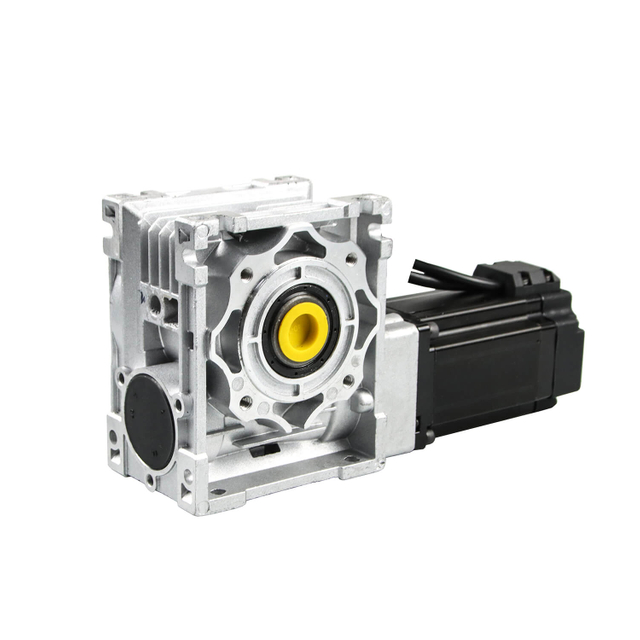
A NEMA 23 worm gear stepper motor is a hybrid device that integrates a NEMA 23-sized stepper motor (2.3 × 2.3 inches faceplate) with a worm gear reducer. The worm gearbox is mounted to the output shaft of the stepper motor, providing gear reduction and torque amplification while maintaining compact dimensions.
This configuration allows the motor to rotate its output shaft at slower speeds with higher torque, making it ideal for applications that demand high precision at low speeds such as CNC positioning, robotic joints, and conveyor systems.
The worm gear mechanism uses a threaded worm shaft that meshes with a toothed worm wheel, creating a high reduction ratio and ensuring self-locking properties, which prevent back-driving when the motor is not powered.
Ne![stepper motor with worm gearbox]() ma 17 23 24 34 Worm Gear Stepper Motor
ma 17 23 24 34 Worm Gear Stepper Motor
What is Worm Geared Stepper Motor?
A worm geared stepper motor is a specialized motion control device that combines the precision of a stepper motor with the high torque and compact design of a worm gearbox. This configuration is widely used in applications that require precise positioning, low-speed control, and high torque output, such as robotics, automation, CNC machinery, and surveillance systems.
A worm geared stepper motor integrates two essential components:
Stepper Motor: Converts electrical pulses into discrete mechanical movements or steps. Each pulse moves the shaft by a specific angle, allowing for accurate control of rotation.
Worm Gearbox: A gear system consisting of a worm (screw-like shaft) and a worm wheel (gear). This setup changes the direction of motion and significantly increases torque output while reducing rotational speed.
The combination of these two components results in a compact and powerful motion system that offers high torque, precise control, and excellent holding strength, even when the power is off.
The NEMA 23 worm gear stepper motor combines the precise step-by-step control of a NEMA 23 stepper motor with the high-torque, low-speed advantages of a worm gear reducer. This integration creates a compact yet powerful drive solution that ensures smooth motion, superior load handling, and exceptional positioning accuracy.
1. Core Components of the NEMA 23 Worm Gear Stepper Motor
A NEMA 23 worm gear stepper motor consists of two main parts:
a. NEMA 23 Stepper Motor
The NEMA 23 stepper motor features a 2.3 x 2.3-inch mounting faceplate, and typically offers 200 steps per revolution (1.8° step angle) or 400 steps per revolution (0.9° step angle). It converts electrical pulses into precise mechanical rotations, providing accurate position control without needing feedback systems.
b. Worm Gear Reducer
Attached directly to the stepper motor shaft is a worm gearbox. It consists of:
This combination creates gear reduction, slowing down the motor’s speed while multiplying its torque output.
2. Stepper Motor Operation: Step-by-Step Motion
The NEMA 23 stepper motor works through electromagnetic induction. When the motor driver sends electrical pulses to the motor’s stator windings, each pulse energizes specific coils, generating magnetic fields that pull the rotor teeth into alignment with the energized stator poles.
As the sequence of pulses continues, the rotor moves incrementally (in steps), rotating with high precision. The number of steps per revolution depends on the step angle and driver microstepping settings.
For example:
A 1.8° step angle motor completes 200 steps per full rotation.
When driven with microstepping (e.g., 1/16), it can achieve up to 3,200 microsteps per revolution, offering ultra-smooth motion.
3. Worm Gear Reduction: Converting Speed to Torque
Once the motor shaft turns, its motion is transmitted into the worm gear system. Here’s how the worm gear mechanism functions:
The motor rotates the worm shaft, which resembles a threaded screw.
The threads of the worm shaft engage with the teeth of the worm wheel.
As the worm shaft turns, it drives the worm wheel at a much slower rotational speed, determined by the gear ratio.
4. Self-Locking Mechanism of the Worm Gear
One unique advantage of worm gear stepper motors is their self-locking ability. Because of the angular contact between the worm shaft and worm wheel, the motion can only travel in one direction—from the worm to the wheel.
This means when power is cut off:
The worm wheel cannot back-drive the worm shaft,
Preventing unwanted movement or slippage,
Providing natural braking and position holding.
This is especially useful in vertical lifting systems, robotic arms, and any application where safety and stability are essential.
5. Synchronization of Electrical Control and Mechanical Output
The motor driver controls the NEMA 23 stepper motor by sending timed electrical pulses. Each pulse corresponds to a precise angular step of the rotor. The worm gearbox then translates these small, fast steps into slow, powerful, and stable output motion.
The overall relationship between input steps and output rotation depends on both the motor’s step angle and gear reduction ratio.
Example Calculation:
If a motor has:
Then:
Output shaft rotation = 200 × 20 = 4,000 steps per revolution.
This means each step moves the output shaft by 0.09°, resulting in extremely fine positioning resolution.
6. Efficiency and Motion Characteristics
Worm gear stepper motors are optimized for low-speed, high-torque operations. However, due to the sliding friction between worm and wheel surfaces, the mechanical efficiency typically ranges between 40–85%, depending on:
Despite this, the design’s smooth operation, reduced backlash, and quiet running make it ideal for precision-driven automation tasks.
7. Electrical and Mechanical Integration
The integration of stepper and worm gear systems simplifies machine design:
The motor driver regulates the stepper coils, ensuring consistent torque and controlled acceleration.
The gearbox provides the desired mechanical output speed and torque multiplication.
Some modern versions also integrate encoders or closed-loop control, providing feedback for higher accuracy and automatic correction of missed steps.
This seamless combination makes the NEMA 23 worm gear stepper motor a ready-to-install motion solution suitable for professional-grade machinery.
8. Key Benefits of the Working Mechanism
The unique way in which the NEMA 23 worm gear stepper motor operates results in several performance benefits:
Enhanced torque density: Gear reduction significantly boosts torque output.
Fine positioning: Increased step resolution ensures accurate control.
Self-locking stability: Prevents mechanical drift or slippage when unpowered.
Low-speed efficiency: Ideal for precise movements at slow rotational speeds.
Compact power system: Combines high torque and precision in a small footprint.
Conclusion
In essence, the NEMA 23 worm gear stepper motor works by merging electrical step-based control with mechanical torque multiplication. The stepper motor delivers exact rotational increments, while the worm gearbox translates that motion into slow, powerful, and precise output movement—all with built-in self-locking stability.
This design not only enhances torque performance but also ensures long-term reliability and precision, making it an indispensable component in CNC machines, automation systems, and robotics applications where accuracy and power must work hand in hand.
The NEMA 23 worm gear stepper motor is a powerful and precise motion control solution that combines the accuracy of a NEMA 23 stepper motor with the torque-enhancing capability of a worm gearbox. This combination makes it an ideal choice for applications that demand high torque, fine positioning, and compact design.
Below are the key features that make NEMA 23 worm gear stepper motors stand out in industrial automation, robotics, and precision control systems.
1. High Torque Output
One of the most distinctive features of a NEMA 23 worm gear stepper motor is its significantly increased torque output. The worm gearbox acts as a torque multiplier, enabling the motor to deliver much higher torque than a standard NEMA 23 stepper motor alone.
Depending on the gear ratio, the torque output can be increased by 5x to 100x, providing exceptional holding and driving power. This makes it perfect for lifting mechanisms, rotary tables, conveyors, and robotic joints where high torque is essential at low speeds.
2. High Precision and Fine Positioning
The step-by-step motion of the stepper motor combined with the gear reduction of the worm drive offers outstanding precision. For instance, a motor with a 1.8° step angle paired with a 20:1 gearbox produces an output resolution of 0.09° per step.
This ultra-fine positioning capability ensures precise movement control, which is crucial for CNC machines, automated assembly lines, and laser engraving systems.
3. Self-Locking Capability
A key mechanical advantage of the worm gear system is its self-locking feature. The unique tooth geometry of the worm and worm wheel prevents the gear from being back-driven.
This means that even when power is turned off, the output shaft remains locked in position, preventing unwanted motion or slippage. This feature ensures mechanical stability and safety, particularly in vertical drives, hoists, and positioning systems.
4. Compact and Space-Saving Design
The NEMA 23 worm gear stepper motor integrates the motor and gearbox into a single, compact assembly. This space-saving configuration eliminates the need for additional external gearing systems, simplifying mechanical design and installation.
The compact form factor allows it to fit easily into tight machine enclosures or portable automated equipment, making it an excellent choice for engineers who require high performance in limited spaces.
5. Smooth and Quiet Operation
The worm gear mechanism provides natural damping, which results in smooth and quiet motion compared to other gear systems like spur or planetary gears.
This quiet operation is particularly beneficial in applications where noise reduction is important, such as medical equipment, laboratory automation, and camera positioning systems. The continuous gear engagement also minimizes vibration, leading to stable and fluid movement.
6. High Load Capacity
Thanks to the gear reduction and increased torque, these motors can handle heavier loads efficiently without losing accuracy. The worm gearbox distributes mechanical stress evenly, allowing for reliable operation even under constant or intermittent heavy-duty cycles.
This makes the NEMA 23 worm gear stepper motor suitable for industrial automation, robotics, and conveyor applications, where performance under load is critical.
7. Enhanced Durability and Long Service Life
NEMA 23 worm gear stepper motors are built for continuous and reliable operation. The gears are typically made from hardened steel or bronze and are lubricated for life, ensuring minimal wear and tear even under high torque conditions.
Their sealed design also helps protect internal components from dust, debris, and moisture, increasing the motor’s lifespan and reducing maintenance requirements.
8. Minimal Backlash
Backlash, or unwanted play between gear teeth, can affect motion precision. Worm gear stepper motors are designed with tight gear tolerances that minimize backlash, ensuring accurate and repeatable positioning.
Low-backlash models are often used in robotic arms, pick-and-place systems, and motion platforms, where precision and repeatability are non-negotiable.
9. Energy Efficiency at Low Speeds
Unlike many other motor types, NEMA 23 worm gear stepper motors maintain high torque even at low rotational speeds. This eliminates the need for high RPM operation, reducing energy consumption and heat generation while maintaining smooth, controlled motion.
This makes them particularly effective for slow-speed, high-accuracy applications such as indexing tables, inspection systems, and dosing mechanisms.
10. Maintenance-Free Operation
The integrated gearbox is often factory-sealed and pre-lubricated, meaning it requires little to no maintenance throughout its lifespan. The combination of robust construction and high-quality materials ensures dependable, long-term operation without frequent servicing.
This not only reduces downtime and maintenance costs but also enhances overall system reliability.
11. Customizable Gear Ratios
The worm gear assembly can be customized with different gear reduction ratios, typically ranging from 5:1 to 100:1. This allows users to tailor torque and speed characteristics to match the specific requirements of their application.
A higher gear ratio delivers greater torque but slower speed, while a lower ratio provides faster response with moderate torque. This flexibility gives engineers full control over performance optimization.
12. Excellent Compatibility and Integration
NEMA 23 worm gear stepper motors follow the standard NEMA 23 frame size, ensuring compatibility with a wide range of mounting brackets, couplers, and drivers.
They can be paired easily with open-loop or closed-loop drivers, motion controllers, and PLC systems, making integration into existing setups seamless.
13. Reliable Performance in Vertical or Load-Holding Applications
Because of their self-locking capability and high holding torque, NEMA 23 worm gear stepper motors perform exceptionally well in vertical applications where the load must be held securely when the motor is idle.
This includes elevators, lifts, robotic joints, and automated positioning equipment, where preventing downward drift is vital for both safety and accuracy.
14. Versatile Mounting Options
These motors are available in multiple mounting configurations—such as hollow-shaft, right-angle, or flange mount designs—to suit diverse installation needs. This flexibility allows engineers to design efficient mechanical layouts that optimize space, alignment, and torque transmission.
15. Optional Closed-Loop Feedback
Some NEMA 23 worm gear stepper motors come with integrated encoders or closed-loop control systems. These advanced models provide real-time feedback, ensuring that the motor maintains its position even under varying load conditions.
Closed-loop operation also reduces step loss, improves efficiency, and enhances motion accuracy, ideal for high-performance automation systems.
Conclusion
The NEMA 23 worm gear stepper motor is a versatile, reliable, and high-performance solution that blends precision with power. Its combination of high torque output, fine resolution, self-locking stability, and compact design makes it an ideal choice for applications demanding accurate, quiet, and durable motion control.
Whether used in robotics, CNC machinery, conveyor systems, or automation, this motor offers an excellent balance of control, efficiency, and longevity, ensuring superior results in every operation.
The NEMA 23 worm gear stepper motor is a powerful and efficient motion control solution that combines precise stepper technology with the torque multiplication benefits of a worm gear reducer. This integration provides numerous mechanical and operational advantages, making it a preferred choice for a wide range of automation, robotics, and industrial applications.
Below, we explore in detail the main advantages of using a NEMA 23 worm gear stepper motor and how these benefits translate into enhanced performance, reliability, and control.
1. Superior Torque Output
One of the most significant advantages of a NEMA 23 worm gear stepper motor is its high torque capability. The worm gearbox functions as a torque amplifier, multiplying the motor’s original torque output based on the gear ratio.
For example, a standard NEMA 23 stepper motor delivering 2 N·m of torque can reach 40 N·m or more with an appropriate gear reduction (e.g., 20:1). This dramatic increase in torque allows the motor to handle heavier loads while maintaining precise control at low speeds.
This makes it ideal for applications such as CNC rotary tables, lifting mechanisms, conveyor drives, and robotic arms, where strong torque and accuracy are critical.
2. Enhanced Positional Accuracy
Stepper motors are inherently precise, but when combined with a worm gear reducer, the positional accuracy improves even further. The gear reduction divides the stepper motor’s movement into smaller increments, providing finer angular resolution.
For instance, a motor with a 1.8° step angle paired with a 20:1 gearbox results in an effective output step angle of just 0.09°. This means smoother, more controlled motion, and virtually no overshoot or vibration during operation.
Such precision is invaluable in laser cutting, camera positioning systems, automated inspection, and micro-assembly equipment where accuracy defines performance quality.
3. Self-Locking and Back-Drive Prevention
A major mechanical advantage of the worm gear system is its self-locking ability. The unique gear geometry allows power transmission only in one direction—from the worm shaft to the worm wheel.
This ensures that when the motor is not energized, the output shaft cannot be back-driven, effectively locking the position without the need for additional brakes or holding mechanisms.
This feature provides inherent safety and stability, especially in vertical lift systems, robotic joints, and load-holding applications, preventing motion drift or accidental drop when power is cut off.
4. Compact and Integrated Design
The NEMA 23 worm gear stepper motor integrates both the motor and gearbox into a single compact assembly. This design saves space, reduces the need for external gearing systems, and minimizes mechanical complexity.
Its space-efficient form factor makes it suitable for machines where compactness is key, such as 3D printers, automated packaging lines, and medical instruments. The integrated design also enhances mechanical alignment, reducing assembly errors and improving overall reliability.
5. Smooth and Quiet Operation
Unlike spur or planetary gears that produce noise and vibration, worm gear stepper motors deliver exceptionally smooth and quiet motion. The sliding contact between worm and gear teeth dampens vibration naturally, resulting in stable and silent operation.
This makes them perfect for environments that demand low noise performance, such as laboratories, hospitals, or camera positioning systems. The smoothness of motion also improves accuracy in systems requiring fine and steady movements.
6. High Load-Holding Capability
Because of their high reduction ratios and torque output, NEMA 23 worm gear stepper motors can hold static loads with impressive stability. Even without power, the self-locking gearbox can maintain a fixed position under load, which significantly improves system safety and reliability.
This feature is particularly advantageous in elevators, robotic arms, gantry systems, and indexing tables, where position holding without slippage is critical.
7. Reduced Backlash and High Stability
The worm gear mechanism provides tight engagement between teeth, minimizing backlash (the unwanted play or gap between gear teeth). This results in consistent and repeatable motion, crucial for tasks that require precise start-stop positioning.
Reduced backlash improves rotational stability, ensuring accurate movement every time, which is beneficial in robotics, pick-and-place systems, and precision assembly machinery.
8. Maintenance-Free and Durable
The NEMA 23 worm gear stepper motor is designed for long-term reliability. The worm gearbox is typically sealed and pre-lubricated, offering maintenance-free operation throughout its lifespan.
High-quality materials like bronze worm wheels and hardened steel worms provide excellent wear resistance, while the sealed housing protects internal parts from dust, debris, and moisture.
This ensures consistent performance and low maintenance costs, even in continuous-duty industrial applications.
9. Excellent Performance at Low Speeds
Unlike many motors that lose torque at low RPMs, the NEMA 23 worm gear stepper motor maintains strong torque output even at slow speeds. The gear reduction allows for smooth, controlled motion with no need for additional reduction mechanisms.
This makes it ideal for slow-speed, high-precision applications, such as metering systems, conveyor indexing, and inspection machinery, where steady movement is more important than high speed.
10. Flexible Gear Ratios and Design Options
NEMA 23 worm gear stepper motors are available in various gear reduction ratios, typically ranging from 5:1 up to 100:1, allowing engineers to select the perfect balance between speed and torque.
Additionally, they can be configured with solid or hollow output shafts, right-angle gear arrangements, or custom mounting options to fit different design requirements. This flexibility enables seamless integration into a wide range of machine architectures.
11. Energy Efficiency and System Simplification
By combining the stepper motor and gearbox into a single assembly, these motors simplify system design and improve energy efficiency. The high torque output at low speeds reduces the need for external gearing, clutches, or braking systems, minimizing energy losses and improving overall system efficiency.
This not only saves space but also reduces component costs and streamlines installation.
12. High Compatibility with Modern Control Systems
NEMA 23 worm gear stepper motors are compatible with standard stepper motor drivers and can easily integrate into open-loop or closed-loop control systems. They work seamlessly with microstepping drivers, PLCs, and motion controllers, ensuring precise synchronization and easy programming.
Advanced versions with integrated encoders offer real-time position feedback, allowing for closed-loop operation that enhances accuracy and prevents missed steps.
13. Ideal for Vertical and Safety-Critical Applications
Thanks to their self-locking capability and excellent holding torque, NEMA 23 worm gear stepper motors are particularly suited for vertical lifting mechanisms, safety-critical machines, and load-holding devices.
Even in the event of a power failure, the self-locking worm gear prevents motion, ensuring safety and positional integrity—a crucial factor in industrial automation and robotics.
14. Cost-Effective and Reliable Motion Solution
Compared to servo systems that require complex feedback mechanisms, NEMA 23 worm gear stepper motors offer a cost-effective solution without compromising on performance. They provide high torque, precision, and reliability at a fraction of the cost, making them ideal for both small-scale and large-scale automation projects.
Their simple control structure, robust design, and low maintenance requirements translate into a lower total cost of ownership over time.
Conclusion
The NEMA 23 worm gear stepper motor delivers an exceptional combination of high torque, precise motion, and mechanical stability in a compact and durable package. Its self-locking design, quiet performance, and high positional accuracy make it one of the most versatile motion control solutions available today.
Whether in robotics, CNC machinery, material handling, or automation systems, this motor offers the perfect balance of power, control, and efficiency—ensuring smooth, reliable, and energy-efficient operation for years to come.
NEMA 23 Worm Gear Stepper Motors are highly valued in modern motion control systems for their exceptional torque performance, precision, and compact design. By combining the NEMA 23 stepper motor with a worm gear reducer, these motors provide superior speed reduction, higher torque output, and enhanced positional stability, making them a preferred choice across various industries. Below, we explore the most prominent applications of NEMA 23 worm gear stepper motors and how their unique features benefit each field.
1. CNC Machinery and Automation Systems
In CNC (Computer Numerical Control) machines, accuracy and torque control are paramount. The NEMA 23 worm gear stepper motor provides smooth and controlled motion, essential for precise cutting, milling, drilling, and engraving operations.
The worm gear mechanism ensures:
High torque at low speeds, which is ideal for tool positioning and heavy-load operation.
Self-locking capabilities, preventing mechanical backlash and ensuring the cutting head or tool maintains its position even when powered off.
These qualities make them indispensable in CNC routers, milling machines, plasma cutters, and engraving systems.
2. Robotics and Automation Equipment
In the robotics industry, precision motion and stability are crucial. NEMA 23 worm gear stepper motors enable fine-tuned movements, especially for robotic arms, pick-and-place systems, and automated inspection machines.
Their high reduction ratio provides the slow, steady, and powerful motion needed to manipulate objects with accuracy. Moreover, their self-locking worm gear ensures the robotic joints hold their position firmly without consuming additional power, improving energy efficiency and reliability.
3. Conveyor and Material Handling Systems
In conveyor systems, consistent motion and precise positioning are essential for automated production lines and logistics. The NEMA 23 worm gear stepper motor delivers controlled rotational motion to move loads efficiently.
Key benefits include:
High load-bearing torque for transporting heavy or irregular items.
Reliable braking and self-locking when the system stops, preventing unwanted motion.
Compact design, allowing easy integration into conveyor frameworks.
These motors are widely used in packaging, labeling, bottling, and sorting equipment where accuracy and torque stability are critical.
4. Medical and Laboratory Equipment
In the medical and laboratory sectors, precision, silence, and stability are non-negotiable. NEMA 23 worm gear stepper motors are utilized in automated analyzers, dispensing systems, imaging devices, and laboratory robots.
The worm gear’s smooth operation ensures quiet motion, which is beneficial for sensitive environments like hospitals and labs. Additionally, the precise step control guarantees accurate dosage, alignment, and mechanical positioning.
5. 3D Printers and Additive Manufacturing
Advanced 3D printers and additive manufacturing systems demand precise axis control and high torque for moving print heads and build platforms. The NEMA 23 worm gear stepper motor delivers both—ensuring accurate layer alignment and consistent printing performance.
Its compact yet powerful design allows it to operate quietly and efficiently even under continuous load, improving the print quality and mechanical reliability of industrial-grade 3D printers.
6. Surveillance and Camera Positioning Systems
Pan-tilt camera systems, telescopes, and surveillance platforms benefit from the self-locking and smooth rotational control of NEMA 23 worm gear stepper motors.
When integrated into camera gimbals or positioning systems, the worm gear ensures vibration-free, stable movement, essential for high-resolution imaging and tracking applications. The locking capability also prevents drift when the motor is idle, keeping the camera’s orientation stable.
7. Textile and Printing Machines
In textile machinery and large-format printers, motion accuracy directly affects production quality. NEMA 23 worm gear stepper motors enable precise tension control, roller movement, and fabric or paper feeding.
Their consistent torque output ensures:
Even tension in fabric handling.
Accurate print head alignment.
Long operational life under repetitive cycles.
Thus, these motors contribute to enhanced print clarity, uniform fabric quality, and reduced maintenance costs.
8. Turntables, Rotary Tables, and Display Systems
For rotary tables, exhibition stands, and automated display systems, NEMA 23 worm gear stepper motors provide stable rotation and perfect positional hold.
Because of the worm gear’s locking feature, the platform stays securely in place even without power, which is particularly beneficial for museum displays, trade show setups, or industrial inspection turntables.
Additionally, their smooth, vibration-free motion enhances user experience and mechanical longevity.
9. Gate, Door, and Lift Mechanisms
In automated gates, shutters, and elevator systems, safety and torque retention are vital. The NEMA 23 worm gear stepper motor offers excellent load-holding capacity and controlled movement for vertical or horizontal actuation.
Its self-locking ability prevents accidental drops or motion when the motor stops, providing additional safety and reducing the need for external braking mechanisms.
10. Packaging and Food Processing Equipment
In the food and packaging industry, reliability, hygiene, and precision control are top priorities. NEMA 23 worm gear stepper motors are used to drive feeders, sealing devices, labeling systems, and automated dispensers.
Their high torque and positional control ensure that packaging components move in synchronized timing, leading to consistent filling, sealing, and labeling accuracy. Moreover, their durable and enclosed design can withstand demanding environments, including moisture and temperature fluctuations.
11. Solar Tracking Systems
For solar panels and heliostats, precise angular positioning is necessary to maximize sunlight exposure. The NEMA 23 worm gear stepper motor provides accurate and stable tracking movement.
The self-locking worm gear keeps the solar panel fixed in place even during strong winds, ensuring both efficiency and safety. These features make it a preferred choice for solar tracking applications that demand high torque and minimal back-driving.
12. Industrial Inspection and Measuring Systems
In inspection equipment such as optical scanners, CMMs (Coordinate Measuring Machines), and alignment tools, accuracy is critical. The NEMA 23 worm gear stepper motor ensures micrometer-level positioning and repeatable motion control, enabling consistent, high-precision measurement outcomes.
Conclusion
The NEMA 23 Worm Gear Stepper Motor stands out as a versatile and powerful motion control solution that combines high torque, excellent positioning accuracy, and robust performance. From industrial automation to robotics, medical systems, and renewable energy applications, it serves as a reliable choice for engineers and designers seeking efficiency, stability, and precision in motion control.
Selecting the right NEMA 23 worm gear stepper motor is essential for ensuring optimal performance, reliability, and efficiency in your motion control application. These motors combine the precision of a stepper motor with the torque multiplication of a worm gearbox, making them ideal for automation, robotics, CNC machinery, and more. However, not all NEMA 23 worm gear stepper motors are the same. Choosing the right one requires evaluating several technical parameters and application-specific factors.
Below, we provide a comprehensive guide to help you choose the best NEMA 23 worm gear stepper motor for your needs.
1. Determine Your Torque Requirements
One of the first considerations is torque—the rotational force needed to move your load.
Holding Torque: This defines how much force the motor can maintain when it is stopped. Applications like CNC tables or camera mounts often require high holding torque to prevent motion drift.
Output Torque (after gear reduction): The worm gear significantly increases torque while reducing speed. Determine the gear ratio needed based on your load’s resistance and required speed.
For example, a 50:1 worm gear ratio can deliver exceptionally high torque at a lower output speed, suitable for heavy-load and precision positioning systems.
2. Consider the Gear Ratio
The gear ratio defines the relationship between the motor’s input speed and the output shaft’s speed.
A higher gear ratio (e.g., 50:1 or 100:1) offers greater torque and self-locking stability, ideal for heavy or vertical loads.
A lower gear ratio (e.g., 10:1 or 20:1) provides faster motion and is suited for lighter loads requiring quick response times.
Selecting the correct ratio ensures that your system achieves the right balance between speed, torque, and positioning accuracy.
3. Match the Motor Voltage and Current Ratings
Your system’s power supply must be compatible with the motor’s electrical specifications.
Voltage: Typically, NEMA 23 stepper motors are available in 12V, 24V, and 48V versions. Higher voltages allow faster response and better torque at higher speeds, but require matching drivers.
Current: Check the phase current rating (usually between 2A–4A). The driver must support or slightly exceed this current to prevent overheating and power loss.
Using a mismatched driver or power supply can result in performance inefficiencies or motor damage.
4. Evaluate Speed and Step Resolution
Stepper motors operate in discrete steps, and the step angle determines how precisely the motor can position.
A typical NEMA 23 stepper motor has a 1.8° step angle (200 steps per revolution).
Combined with a worm gearbox, this resolution increases dramatically. For instance, with a 50:1 ratio, the effective output step angle becomes 0.036°, providing ultra-fine motion control.
Applications such as robotic joints, camera pan-tilt systems, or laboratory automation benefit from such high precision.
5. Check Mounting and Shaft Configurations
The mechanical interface must fit your design requirements.
Mounting Type: Ensure the worm gear housing matches the NEMA 23 flange standard (57mm × 57mm). Some models include integrated flanges or custom mount brackets.
Output Shaft Type: Options include hollow shafts, solid shafts, or double-shaft extensions. Choose based on whether your system needs direct coupling, belt drive, or dual-ended rotation.
Proper alignment between the motor and the load minimizes vibration and extends motor lifespan.
6. Consider Backlash and Positioning Accuracy
Backlash refers to the small amount of play or lost motion between gear teeth. In high-precision applications such as CNC machining or optical systems, even slight backlash can affect performance.
A low-backlash configuration ensures smoother motion, tighter positional control, and higher repeatability.
7. Factor in Self-Locking Capabilities
One major benefit of worm gear mechanisms is their self-locking nature—the motor cannot be easily back-driven.
However, not all worm gear ratios provide the same level of locking.
High gear ratios (e.g., 40:1 and above) generally ensure full self-locking, ideal for vertical lifts or holding mechanisms.
Lower ratios may allow minor back-driving under heavy loads.
If your system requires the load to stay fixed without power, choose a fully self-locking worm gear configuration.
8. Assess Efficiency and Heat Dissipation
Worm gear drives, while powerful, can produce more frictional heat than spur or planetary gears.
Select motors with high mechanical efficiency (typically 60–80% for quality worm gears).
Ensure the motor housing includes aluminum or cast-iron construction for better thermal dissipation.
For continuous-duty applications, consider integrating a cooling fan or heat sink.
Proper thermal management prevents overheating, torque loss, and premature wear.
9. Choose a Compatible Stepper Motor Driver
A compatible driver is crucial for achieving smooth operation and microstepping accuracy.
Look for drivers supporting microstepping control (e.g., 1/16 or 1/32 step modes) for finer motion resolution.
Ensure it matches the motor’s voltage and current specifications.
Consider closed-loop stepper drivers if you need feedback-based control to prevent step loss and improve torque utilization.
Pairing the motor with the right driver ensures silent, efficient, and accurate performance.
10. Evaluate Build Quality and Brand Reputation
The manufacturing quality of the NEMA 23 worm gear stepper motor directly affects durability and precision.
When choosing, prioritize:
Reputable brands with proven performance records.
High-quality materials such as hardened steel worm gears and precision bearings.
IP-rated enclosures for protection against dust, oil, and moisture (ideal for industrial environments).
Opting for a reliable, high-quality motor reduces maintenance costs and ensures long-term stability.
11. Verify Application-Specific Requirements
Every project has unique operational needs. Before finalizing your motor selection, consider:
Load type: Linear, rotary, or variable inertia.
Operating environment: Temperature, humidity, vibration, and exposure to contaminants.
Duty cycle: Continuous vs. intermittent operation.
Mounting orientation: Horizontal or vertical installation, as it affects gear lubrication and load stress.
Tailoring your selection to these factors ensures maximum system efficiency and reliability.
12. Compare Cost vs. Performance
While cost is always a consideration, selecting the cheapest option can lead to long-term inefficiencies.
Evaluate performance metrics (torque, speed, precision) relative to price.
Invest in mid-to-high-end models for demanding applications where accuracy and durability are critical.
Balance your budget with the required performance specifications to achieve optimal ROI.
Conclusion
Choosing the right NEMA 23 Worm Gear Stepper Motor involves balancing mechanical performance, electrical compatibility, and precision requirements. By evaluating key parameters such as torque, gear ratio, voltage, backlash, and self-locking features, you can select the perfect motor for your application—whether it’s for automation, robotics, CNC systems, or industrial machinery.
A well-matched NEMA 23 worm gear stepper motor ensures superior control, durability, and operational efficiency, empowering your system to perform with accuracy and reliability for years to come.
The worm gear stepper motor has long been a cornerstone of precision motion control in industries such as robotics, automation, CNC machinery, and renewable energy. Combining the accuracy of stepper motors with the torque-multiplying power of worm gears, these motors have become indispensable for applications requiring precise positioning, high torque, and compact design.
As technology continues to evolve, future trends in worm gear stepper motors are being driven by demands for greater efficiency, intelligence, miniaturization, and connectivity. Below, we explore the emerging innovations that are shaping the next generation of worm gear stepper motors.
1. Integration of Smart Control and Feedback Systems
One of the most significant trends in the evolution of worm gear stepper motors is the integration of closed-loop feedback systems. Traditional stepper motors operate in open-loop mode, meaning they lack position feedback. However, future designs increasingly feature integrated encoders and sensors that allow the system to monitor position, speed, and torque in real-time.
Key advancements include:
Closed-loop stepper systems that automatically correct missed steps, ensuring accurate positioning even under varying loads.
Smart controllers capable of adaptive tuning and fault diagnostics.
Built-in communication interfaces like CANopen, Modbus, or EtherCAT, enabling seamless integration into industrial networks.
This shift toward intelligent motion control will make worm gear stepper motors more reliable, efficient, and compatible with Industry 4.0 automation ecosystems.
2. Improved Energy Efficiency and Heat Management
Traditional worm gears, while excellent for torque multiplication, can suffer from efficiency losses due to friction. Manufacturers are now focusing on advanced materials, lubrication systems, and design improvements to minimize energy loss and heat buildup.
Future worm gear stepper motors will feature:
High-efficiency worm gear profiles with optimized tooth geometry to reduce sliding friction.
Low-friction coatings and synthetic lubricants for smoother operation.
Enhanced thermal management, including heat sinks, integrated cooling fins, and temperature sensors.
These innovations aim to achieve higher mechanical efficiency (up to 90%), enabling longer operation times, reduced power consumption, and improved performance in continuous-duty applications.
3. Compact and Lightweight Designs
As industries push for space-saving automation solutions, the demand for compact yet powerful stepper motors is growing. Future worm gear stepper motors are expected to be smaller, lighter, and more modular without sacrificing torque or precision.
Manufacturers are leveraging:
High-density magnetic materials for stronger torque in smaller packages.
Lightweight aluminum alloy housings for improved heat dissipation and reduced weight.
Integrated motor-gear assemblies, minimizing space while simplifying installation.
These advancements will make worm gear stepper motors ideal for medical equipment, collaborative robots (cobots), and portable automation systems where space and weight are critical factors.
4. Enhanced Precision Through Microstepping and Control Algorithms
Precision remains at the heart of motion control. Future worm gear stepper motors will benefit from more refined microstepping technologies and advanced control algorithms that deliver smoother and more accurate motion.
Emerging control features include:
Sub-microstepping for ultra-fine angular control and smoother acceleration curves.
AI-assisted motion control algorithms that predict and compensate for system disturbances.
Adaptive damping techniques to minimize vibration and resonance in high-precision operations.
These innovations will lead to unparalleled motion smoothness and repeatability, making worm gear stepper motors even more suitable for optical devices, CNC positioning systems, and robotic applications.
5. Integration with IoT and Industry 4.0
The rise of the Industrial Internet of Things (IIoT) is transforming how machines communicate, monitor, and self-optimize. Future worm gear stepper motors will increasingly feature IoT connectivity, enabling remote monitoring, predictive maintenance, and data-driven optimization.
Key capabilities will include:
Embedded sensors to track temperature, vibration, and torque load.
Cloud-based analytics for predictive failure detection and performance insights.
Wireless communication allowing real-time data exchange between motor systems and centralized control networks.
This connectivity will allow manufacturers to reduce downtime, optimize motor performance, and achieve greater automation efficiency through data-driven maintenance strategies.
6. Hybrid Gear Technologies
While worm gears offer exceptional torque and self-locking ability, they traditionally lack the efficiency of planetary or spur gear systems. Future designs are moving toward hybrid gear systems that combine the best features of worm and planetary mechanisms.
Advantages of hybrid gearing include:
Increased torque density with reduced mechanical losses.
Higher transmission efficiency compared to conventional worm gears.
Enhanced load distribution, leading to greater durability and reduced wear.
Such designs will bridge the performance gap between high-torque worm systems and high-efficiency planetary drives, creating versatile solutions for industrial and robotics applications.
7. Greater Use of Advanced Materials and Manufacturing Technologies
Material science is playing a key role in improving the performance and longevity of worm gear stepper motors. The adoption of advanced alloys, ceramics, and composite materials will drastically enhance durability, strength, and resistance to wear.
In addition, modern manufacturing technologies such as additive manufacturing (3D printing) are enabling:
Custom gear geometries for optimized torque and reduced backlash.
Lightweight, high-strength housings with complex internal cooling channels.
Rapid prototyping and on-demand customization, reducing lead times and costs.
This trend toward high-performance materials and smart manufacturing will yield motors that are not only stronger but also more efficient and sustainable.
8. Sustainability and Eco-Friendly Design
Environmental sustainability is becoming a core priority in engineering design. Future worm gear stepper motors will incorporate eco-friendly materials, energy-efficient designs, and recyclable components to reduce their environmental footprint.
Innovations include:
Energy-optimized windings and cores for minimal power loss.
Lubrication-free or biodegradable lubricant systems.
Reduced noise and vibration for environmentally conscious operation.
Manufacturers are also adopting green production practices, aligning with global sustainability initiatives such as ISO 14001 and carbon-neutral manufacturing.
9. Customization and Modular Configurations
The growing diversity of automation applications demands custom motor configurations. Future NEMA 23 worm gear stepper motors will adopt modular designs, allowing users to mix and match components to suit their specific operational needs.
This trend will lead to:
Customizable gear ratios and torque outputs.
Interchangeable motor sizes and mounting options.
Plug-and-play compatibility with different control systems.
Modularity ensures greater design flexibility, enabling engineers to rapidly adapt to evolving application requirements without full system redesigns.
10. Integration with Servo-Like Performance
The boundary between stepper motors and servo systems is increasingly blurring. The next generation of worm gear stepper motors will deliver servo-like performance at a fraction of the cost.
Features such as:
will make them capable of achieving smooth acceleration, precise speed regulation, and overload protection—functions traditionally exclusive to servo motors.
This convergence will make worm gear stepper motors the ideal choice for applications demanding high precision, torque stability, and cost-efficiency.
Conclusion
The future of worm gear stepper motors lies in intelligence, efficiency, and adaptability. Through advancements in control systems, materials, connectivity, and precision engineering, these motors will continue to power the next generation of automation, robotics, and smart manufacturing technologies.
As industries move toward sustainable, connected, and autonomous systems, the NEMA 23 worm gear stepper motor and its successors will play a critical role in achieving smarter, cleaner, and more efficient motion control solutions.
The NEMA 23 worm gear stepper motor is a powerful and reliable solution that combines the precision of stepper motion with the torque advantage of worm gear reduction. Its compact size, self-locking capability, and high torque performance make it an ideal choice for numerous industrial and automation applications.
By understanding its working principle, advantages, and selection criteria, engineers can harness its full potential for precise, stable, and efficient motion control in any system.