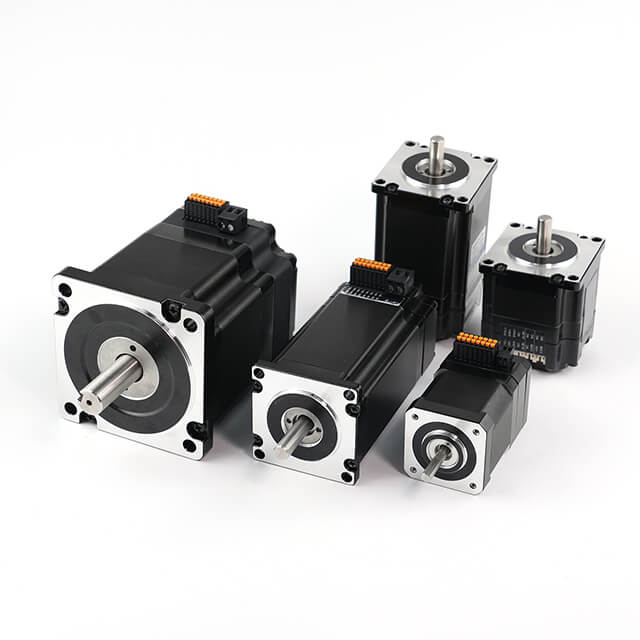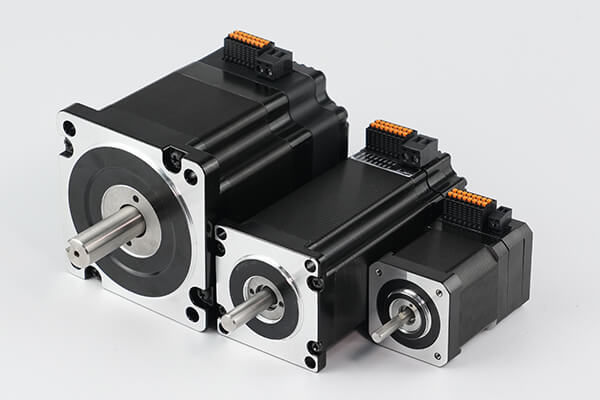
A NEMA 23 integrated stepper motor is a compact motion control solution that combines a stepper motor, driver, and controller into a single integrated unit. This design simplifies installation, reduces wiring complexity, and improves overall system reliability. The name NEMA 23 refers to the standardized faceplate size set by the National Electrical Manufacturers Association (NEMA), where “23” indicates a 2.3-inch (57.15 mm) square faceplate dimension.
A NEMA 23 integrated stepper motor is a type of hybrid stepper motor that includes built-in electronic components for control and communication. Unlike traditional stepper motors that require external drivers and controllers, the integrated version merges all these functions into one unit.
This design not only saves space and wiring but also provides a more plug-and-play motion control experience, making it ideal for automated systems that demand precision and simplicity.

Nema 11 17 23 24 34 Integrated Stepper Servo Motor
Features of ISC low-voltage Integrated Stepper Servo Motors:
1. Cortex-M4 core high-performance 32-bit microcontroller
2. The highest impulse response frequency can reach 200KHz
3. Built-in protection functions effectively ensure the safe use of the device
4. Intelligently adjust current to reduce vibration, noise and heat
5. Using low internal resistance MOS, the heat generation is 30% lower than that of ordinary products.
6. Voltage range: DC12V ~ DC36V
7. The integrated design of the drive motor is easy to install, takes up little space, and has simple wiring.
8. With anti-reverse connection function
Control method:
1. Pulse type
2. RS485-Modbus-RTU network type
3. CANopen network type
Protection level:
Waterproof type: IP30 IP54 IP65 optional
A NEMA 23 integrated stepper motor is a sophisticated motion control device that merges the stepper motor, driver, and controller into one compact unit. This integration simplifies the system design while delivering precise position and speed control. Understanding how it works requires examining the mechanical, electrical, and control aspects that allow it to operate efficiently and accurately.
1. The Basic Principle of Operation
At the core of every stepper motor, including the NEMA 23, lies the principle of electromagnetic induction. The motor converts electrical pulses into mechanical motion, moving the shaft in fixed angular steps. Each pulse sent to the motor corresponds to a single step, allowing for precise angular positioning without the need for external feedback in open-loop systems.
A NEMA 23 integrated stepper motor typically has a 1.8° step angle, meaning 200 steps per revolution. Through microstepping, the control system can subdivide these steps into smaller increments, achieving smoother rotation and higher precision.
2. The Integration of Components
What makes the NEMA 23 integrated stepper motor unique is that it combines three critical components into one housing:
a. Stepper Motor
The motor itself consists of:
When the stator coils are energized in sequence, the rotor aligns itself with the magnetic field, causing the shaft to rotate step by step.
b. Integrated Driver
The driver is the electronic interface that receives low-power control signals from the controller and delivers high-power current to the motor windings. It regulates the current flow, switching sequence, and microstepping resolution.
Modern integrated drivers use chopper control technology and PWM (Pulse Width Modulation) to maintain constant torque and efficient operation even under varying loads.
c. Built-In Controller
The controller acts as the “brain” of the system. It interprets external commands (via RS485, CANopen, or Modbus) and generates precise pulse and direction signals for the driver.
Some models come with advanced motion programming capabilities, allowing standalone operation without an external PLC or computer.
3. The Working Process Step-by-Step
Here’s a simplified view of how a NEMA 23 integrated stepper motor operates:
Signal Input – The controller receives position or speed commands from a PLC, PC, or HMI.
Command Processing – The built-in controller translates these signals into pulse and direction instructions.
Current Switching – The driver energizes specific stator windings in a controlled sequence.
Rotor Movement – The rotor aligns with the changing magnetic fields, rotating incrementally.
Feedback (in closed-loop models) – The encoder monitors the actual shaft position and sends data back to the controller to correct errors in real time.
This synchronized process allows for accurate, repeatable, and smooth motion—ideal for precision automation and robotics applications.
4. Closed-Loop vs. Open-Loop Operation
There are two main types of NEMA 23 integrated stepper motors:
Open-Loop System
The motor operates solely on step commands without feedback.
Simple, cost-effective, and reliable for applications that do not require high accuracy.
Limitation: Possible loss of steps under heavy load or acceleration.
Closed-Loop System
Equipped with an encoder to provide real-time position feedback.
The controller continuously compares commanded position to actual position.
Automatically adjusts current and torque to eliminate missed steps.
This closed-loop operation combines the simplicity of stepper motors with the precision of servo systems, enhancing performance in dynamic applications.
5. Electrical Control and Microstepping
The microstepping technique divides each full step into smaller sub-steps by controlling the current in the stator windings proportionally.
For example, in 1/16 microstepping, a standard 1.8° step is divided into 16 smaller steps (0.1125° each). This results in:
The driver uses sine and cosine current waveforms to control the winding current, ensuring consistent torque and accuracy even at low speeds.
6. Communication and Control Interface
Most modern NEMA 23 integrated stepper motors feature advanced communication interfaces such as:
RS485 – For multi-axis control networks
CANopen – Common in industrial automation systems
Modbus RTU – Standard for industrial PLC integration
These interfaces allow real-time monitoring, speed adjustments, and parameter tuning from a central controller or PC, improving system flexibility and efficiency.
7. Heat Dissipation and Efficiency
Because both the motor and driver are housed together, thermal management is critical. NEMA 23 integrated stepper motors are designed with:
Aluminum alloy housings for efficient heat conduction
Optimized ventilation and heat sink structures
Automatic current reduction when idle to minimize heat buildup
These features extend the motor lifespan and ensure consistent performance even under continuous-duty conditions.
8. Mechanical Motion and Torque Characteristics
Stepper motors generate torque based on the strength of the magnetic field and the timing of coil energization. The NEMA 23’s design allows for:
High holding torque (up to 3.0 Nm) for load retention
Stable low-speed performance
Fast acceleration and deceleration response
The torque curve typically decreases as speed increases, but integrated driver algorithms optimize current to maintain steady torque output throughout the operating range.
9. Advantages of Integrated Operation
By merging electrical and mechanical components, NEMA 23 integrated stepper motors offer:
Simplified wiring and compact installation
Reduced electrical noise due to short internal connections
Improved synchronization and control
Plug-and-play setup for industrial automation
These advantages make them ideal for systems such as CNC routers, pick-and-place machines, conveyors, and robotics.
Conclusion
A NEMA 23 integrated stepper motor works through the precise coordination of magnetic fields, electronic control, and intelligent feedback systems. By integrating the motor, driver, and controller into one seamless unit, it provides accurate, efficient, and reliable motion control for a wide range of automation applications.
Its ability to maintain position accuracy, reduce wiring complexity, and adapt to closed-loop feedback makes it an essential component in modern industrial and robotic systems.
Integrated Design – Combines the stepper motor, driver, and controller into a single package.
High Torque Output – Delivers strong holding torque suitable for medium-load industrial applications.
Compact and Efficient – Saves space while maintaining high performance and efficiency.
Closed-Loop Control (optional) – Some models include encoders for real-time feedback and position correction.
Easy Communication – Supports communication interfaces such as RS485, CANopen, or Modbus for smooth integration with PLCs or motion controllers.
Reduced Noise and Vibration – Advanced microstepping technology ensures smoother and quieter operation.
The NEMA 23 integrated stepper motor has become one of the most sought-after motion control solutions across industries, known for its precision, compact design, and high torque output. India, being a global hub for manufacturing and automation, is home to some of the most innovative and reliable NEMA 23 integrated stepper motor manufacturers. Below, we present a comprehensive list of the Top 20 NEMA 23 Integrated Stepper Motor Manufacturers in India, each offering unique advantages, high-quality products, and advanced technological capabilities.
1. Bharat Bijlee Ltd.
Company Profile
Bharat Bijlee is one of India’s leading electrical engineering nema 23 integrated stepper motor manufacturers, established in 1946. With decades of expertise in motion control and automation, the company has built a strong reputation for delivering reliable motor solutions across multiple industries.
Main Products
Their portfolio includes NEMA 23 integrated stepper motors, servo drives, and hybrid stepper systems designed for CNC machines and robotics applications.
Advantages
Proven track record in industrial automation
Strong R&D infrastructure
Custom motor design capabilities
2. Jyoti CNC Automation Ltd.
Company Profile
Jyoti CNC is a leading nema 23 integrated stepper motor manufacturer in machine tool manufacturing, offering integrated motor solutions for precision-driven applications. The company provides high-performance stepper motors and motion control systems.
Main Products
Advantages
3. Texmo Industries
Company Profile
A leading nema 23 integrated stepper motor manufacturer founded in 1956, Texmo Industries is known for its durable and efficient motors used in industrial and automation applications. Their stepper motors are trusted across India for consistent performance.
Main Products
Advantages
High reliability and low maintenance
Excellent heat dissipation
ISO-certified quality control
4. Motion Control Products India Pvt. Ltd.
Company Profile
Specializing in motion control and automation, Motion Control Products India is a leading nema 23 integrated stepper motor manufacturer and offers advanced stepper motor solutions for industrial automation and robotics.
Main Products
Advantages
5. Nippon Pulse Motor Co. (India Division)
Company Profile
A global leader with operations in India, Nippon Pulse is a leading nema 23 integrated stepper motor manufacturer and delivers precision motion control components, including integrated stepper motors for high-end automation.
Main Products
Advantages
High torque-to-size ratio
Exceptional repeatability
Ideal for laboratory and robotics applications
6. Jkongmotor
Company Profile
Jkongmotor is a trusted nema 23 integrated stepper motor manufacturer of electric motors, including high-quality stepper motors for industrial use.
Main Products
Advantages
Robust and durable design
Excellent after-sales service
Wide voltage compatibility
7. Triveni Engineering & Industries Ltd.
Company Profile
Triveni Engineering is a leading nema 23 integrated stepper motor manufacturer and has diversified its expertise into automation, offering precision motion systems. Their stepper motors meet stringent industrial requirements.
Main Products
Advantages
8. Saini Electric Co.
Company Profile
Saini Electric Co. is a leading nema 23 integrated stepper motor manufacturer and has been manufacturing quality motors and drives for decades. Their NEMA 23 motors are used in automation, robotics, and packaging machines.
Main Products
Advantages
9. Sharp Motors
Company Profile
Sharp Motors is a fast-growing Indian nema 23 integrated stepper motor manufacturer specializing in precision electric motors and integrated control systems.
Main Products
Advantages
High torque and acceleration
Suitable for high-speed automation
CE and RoHS certified products
10. Kirloskar Electric Company
Company Profile
Kirloskar Electric is one of India’s oldest and most reputable nema 23 integrated stepper motor manufacturers, serving industries worldwide with advanced motion solutions.
Main Products
NEMA 23 stepper and servo motors
Integrated automation modules
High-efficiency motor controllers
Advantages
Proven reliability
Wide power range
Energy-efficient designs
11. BesFoc Motor
Company Profile
A dedicated motion control company, BesFoc Motor is a nema 23 integrated stepper motor manufacturer and supplies a wide range of integrated stepper motors for precision engineering and automation sectors.
Main Products
Advantages
Cost-effective and reliable
Easy plug-and-play configuration
Strong online technical support
12. Oriental Motor India Pvt. Ltd.
Company Profile
A global motion control leading nema 23 integrated stepper motor manufacturer with a strong Indian presence, Oriental Motor offers technologically advanced stepper solutions for industrial automation.
Main Products
Advantages
13. Anubhuti Enterprises
Company Profile
Anubhuti Enterprises is a leading nema 23 integrated stepper motor manufacturer and specializes in designing compact and efficient motion control solutions, including stepper and servo motor systems.
Main Products
Advantages
Custom engineering support
Strong focus on precision
Affordable high-performance motors
14. Elmotec Antriebstechnik India Pvt. Ltd.
Company Profile
Elmotec is a leading nema 23 integrated stepper motor manufacturer known for manufacturing high-precision electric motors for automation, packaging, and medical device industries.
Main Products
Advantages
Compact structure
Smooth rotation
Low noise and vibration
15. Crompton Greaves Consumer Electricals Ltd.
Company Profile
Crompton Greaves is a well-known nema 23 integrated stepper motor manufacturer in electrical engineering and motor manufacturing, providing robust motion control products for diverse applications.
Main Products
Advantages
16. Autonics India Pvt. Ltd.
Company Profile
Autonics is a global leading nema 23 integrated stepper motor manufacturer in automation components and motion control, offering advanced stepper motor technology with integrated control electronics.
Main Products
NEMA 23 integrated stepper motors
Stepper drives and sensors
PLC-compatible motion systems
Advantages
17. Delta Electronics India
Company Profile
Delta Electronics is a leading nema 23 integrated stepper motor manufacturer and delivers a wide range of automation and motion control products, including high-performance integrated stepper motors.
Main Products
Advantages
Energy-efficient operation
Robust communication interface
Trusted global brand reliability
18. Sure Controls India
Company Profile
Sure Controls India is a leading nema 23 integrated stepper motor manufacturer and focuses on advanced motion solutions with customized designs for industrial automation and robotic systems.
Main Products
Advantages
19. Lubi Electronics
Company Profile
Lubi Electronics is a leading nema 23 integrated stepper motor manufacturer and manufactures and distributes a wide range of automation products, including stepper and servo motors.
Main Products
Advantages
20. Allied Motion Technologies India
Company Profile
A leading nema 23 integrated stepper motor manufacturer in motion control systems, Allied Motion Technologies offers innovative integrated stepper motor solutions for precision industries.
Main Products
Advantages
Advanced feedback and control
Compact and energy-efficient design
High torque and durability
The NEMA 23 integrated stepper motor represents a major advancement in motion control technology, combining the motor, driver, and controller into a single compact and intelligent unit. This design simplifies system integration and enhances performance, making it a preferred choice across industries such as automation, robotics, CNC machinery, packaging, and 3D printing. Below are the key advantages of using NEMA 23 integrated stepper motors that make them stand out from traditional systems.
1. Compact All-in-One Design
One of the most significant advantages of a NEMA 23 integrated stepper motor is its all-in-one structure. By merging the stepper motor, driver electronics, and control logic into a single housing, it eliminates the need for multiple separate components.
Benefits include:
Reduced wiring complexity
Simplified installation and maintenance
Smaller control cabinet requirements
Lower overall system footprint
This compact integration allows engineers to build sleeker and more efficient machines without compromising performance.
2. Simplified Wiring and Installation
Traditional stepper motor systems require external drivers, controllers, and multiple cables to interconnect them. The integrated version drastically reduces this complexity.
Advantages include:
Fewer connections mean faster setup and reduced risk of wiring errors
Quick plug-and-play installation using standard connectors
Lower electromagnetic interference (EMI) due to shorter internal wiring
For machine builders and OEMs, this translates into shorter production time and easier system integration.
3. Cost Efficiency
Although integrated stepper motors may have a slightly higher upfront cost, they significantly reduce total system costs by minimizing additional components and wiring.
Cost benefits include:
No need for separate controllers or external drivers
Fewer cables and connectors
Reduced engineering and assembly time
Lower maintenance and troubleshooting expenses
Over the lifecycle of the equipment, this leads to long-term savings and improved return on investment.
4. High Precision and Position Accuracy
NEMA 23 integrated stepper motors are known for their excellent positioning accuracy, thanks to precise step control and optional closed-loop feedback from built-in encoders.
Key benefits:
Accurate motion control without position drift
Step angles as fine as 1.8° per step, with microstepping capability for smoother operation
Instant response to control signals
This precision makes them ideal for applications requiring fine movement control, such as CNC routers, 3D printers, and medical equipment.
5. Closed-Loop Control for Reliability
Many NEMA 23 integrated stepper motors feature closed-loop control systems, which combine the accuracy of servos with the simplicity of steppers.
Advantages of closed-loop operation:
Real-time feedback from encoders prevents missed steps
Automatic torque adjustment based on load conditions
Improved efficiency and temperature management
Self-correcting performance for high-reliability operation
This hybrid servo-like behavior ensures consistent and stable motion, even under dynamic load conditions.
6. Enhanced Torque and Performance
The NEMA 23 motor frame offers high torque output in a compact size, typically ranging from 1.0 Nm to 3.0 Nm. The integrated driver optimizes current delivery, maintaining strong performance across different speeds.
Performance advantages:
High holding torque for stability in stationary positions
Smooth acceleration and deceleration
Consistent torque curve across the speed range
This makes the motor suitable for medium-load applications such as pick-and-place systems, conveyors, and packaging machinery.
7. Reduced Electrical Noise and Interference
With the driver and controller located directly inside the motor housing, signal paths are shorter, and noise susceptibility is greatly reduced.
Benefits include:
More stable communication signals
Lower risk of data transmission errors
Enhanced performance in electrically noisy industrial environments
This design ensures reliable operation in sensitive applications where consistent performance is critical.
8. Better Heat Management
Integrated stepper motors are designed with efficient heat dissipation mechanisms to ensure long service life and stability.
Thermal advantages:
Aluminum alloy housing acts as a natural heat sink
Intelligent thermal control reduces current when idle
Lower risk of overheating under continuous duty
Improved thermal management enhances both efficiency and durability in long-running applications.
9. Easy Communication and Control
Most NEMA 23 integrated stepper motors support advanced industrial communication protocols, allowing for seamless integration with PLCs, HMIs, and control systems.
Common communication options:
These interfaces enable real-time monitoring, multi-axis synchronization, and remote configuration, improving system flexibility and control.
10. Energy Efficiency
Integrated stepper motors consume power more efficiently than traditional open-loop systems, especially when operating in closed-loop mode.
Energy-saving features include:
Automatic current reduction when idle
Dynamic torque control to prevent overdriving
Optimized microstepping algorithms for smoother and more efficient motion
The result is lower power consumption, reduced heat generation, and extended system lifespan.
11. High Reliability and Low Maintenance
Because all essential components are enclosed in a single unit, the NEMA 23 integrated stepper motor has fewer points of failure.
Reliability benefits:
No external driver cables that can loosen or fail
Sealed housing protects against dust and vibration
Long operational lifespan due to reduced mechanical stress
This reliability minimizes downtime and maintenance costs, ensuring consistent production performance.
12. Flexibility and Scalability
Integrated stepper motors are modular and can be easily scaled for different applications. Whether used as a single-axis controller or part of a multi-axis automation system, their plug-and-play nature allows for effortless expansion.
Flexibility highlights:
Works with various power supplies (24V–48V DC)
Compatible with a wide range of motion control software
Simple parameter configuration for custom motion profiles
This flexibility makes them a preferred choice for OEMs and automation designers.
13. Smooth and Quiet Operation
Thanks to microstepping technology and advanced current control, NEMA 23 integrated stepper motors run with minimal vibration and noise.
Advantages:
This quiet performance is especially beneficial in medical, laboratory, and office automation environments.
14. Wide Range of Applications
The combination of precision, power, and simplicity allows the NEMA 23 integrated stepper motor to serve diverse industries, including:
CNC machining
Robotics and automation
Packaging and labeling
Printing and textile machines
Medical and laboratory devices
3D printing and prototyping
Its versatility makes it a universal motion control solution for engineers and manufacturers.
Conclusion
The NEMA 23 integrated stepper motor offers a perfect blend of efficiency, precision, and reliability. Its compact all-in-one design simplifies system architecture while enhancing performance and control. From reducing wiring complexity to delivering accurate closed-loop motion, it provides a cost-effective and future-ready solution for automation and robotics applications.
By choosing NEMA 23 integrated stepper motors, manufacturers gain superior performance, simplified integration, and long-term operational benefits—a true evolution in motion control technology.
The NEMA 23 integrated stepper motor is a highly versatile and efficient motion control device widely used in industrial automation, robotics, medical equipment, and precision machinery. Its compact design, high torque output, and built-in driver and controller make it an ideal choice for systems that require accurate, reliable, and programmable motion. Below, we explore the key applications of NEMA 23 integrated stepper motors across multiple industries.
1. CNC Machines and Milling Equipment
One of the most common applications of NEMA 23 integrated stepper motors is in CNC (Computer Numerical Control) machines. These motors provide precise angular positioning and repeatability, which are essential for tasks such as milling, drilling, engraving, and cutting.
Key benefits:
Accurate tool movement and path control
Stable torque at low speeds for fine machining
Simplified wiring with integrated driver and controller
Applications include:
The motor’s integrated electronics reduce the need for external controllers, resulting in compact and reliable CNC systems.
2. 3D Printers and Additive Manufacturing
The NEMA 23 integrated stepper motor is also a popular choice in 3D printers, where smooth, precise, and repeatable motion is critical for layer-by-layer material deposition.
Advantages in 3D printing:
High positioning accuracy ensures print precision
Integrated control simplifies printer design
Smooth microstepping reduces vibration and noise
Typical uses:
The motor’s compact size and integrated functionality allow for high-performance and space-efficient printer designs.
3. Robotics and Automation Systems
In robotic arms, pick-and-place machines, and automated assembly systems, NEMA 23 integrated stepper motors deliver the perfect balance of speed, torque, and precision.
Why they’re ideal for robotics:
High torque for joint or axis movement
Smooth motion and low vibration for stability
Closed-loop models prevent step loss during repetitive tasks
Applications include:
Robotic manipulators
Conveyor-based automation
Packaging and palletizing robots
Laboratory automation systems
With built-in control and feedback capabilities, these motors enable intelligent robotic motion while simplifying control architecture.
4. Packaging and Labeling Machines
The packaging industry relies on NEMA 23 integrated stepper motors for precise and synchronized motion control in high-speed operations.
Key roles include:
Controlling conveyor belts
Operating film feeders and sealing heads
Managing labeling and printing mechanisms
Advantages:
Consistent product handling
Reduced maintenance due to fewer external components
Ability to operate multiple axes with networked communication (RS485 or CANopen)
These motors ensure accurate timing and positioning, essential for automated packaging lines that demand reliability and efficiency.
5. Textile and Printing Machinery
In textile and printing equipment, NEMA 23 integrated stepper motors are used to manage complex mechanical operations requiring synchronization, accuracy, and speed control.
Common applications:
Controlling fabric feeders
Operating print heads and rollers
Thread winding and cutting mechanisms
Benefits:
Smooth microstepping for consistent motion
Compact design saves space in multi-axis machinery
Reduced wiring complexity for cleaner installations
The result is flawless, high-speed production with reduced system downtime.
6. Medical and Laboratory Equipment
The medical and life sciences industries demand motion systems that are compact, precise, and reliable. NEMA 23 integrated stepper motors meet these requirements perfectly.
Typical uses:
Automated analyzers and sample handlers
Syringe pumps and dosing systems
Imaging and diagnostic equipment
Robotic laboratory arms
Advantages:
Smooth motion minimizes vibration for sensitive instruments
High precision ensures consistent dosing and analysis
Compact integration supports space-limited devices
With their quiet operation and dependable accuracy, these motors enhance performance in medical automation and laboratory research.
7. Conveyor and Material Handling Systems
In industrial conveyor systems, NEMA 23 integrated stepper motors are used to control movement, positioning, and synchronization of transported materials.
Applications include:
Automated sorting systems
Positioning conveyors for assembly lines
Smart warehousing and logistics systems
Key benefits:
Precise control of speed and acceleration
Robust torque for continuous-duty operation
Reduced wiring and maintenance for large-scale setups
These motors improve overall system efficiency and reliability in logistics and production environments.
8. Surveillance and Camera Positioning Systems
The NEMA 23 integrated stepper motor is also used in pan-tilt camera mounts, telescopes, and other precision positioning devices.
Advantages:
High-resolution microstepping for smooth tracking
Accurate, repeatable angular positioning
Integrated control for easy network communication
Applications:
Security camera motion systems
Astronomy and optical tracking equipment
Stage and lighting control systems
Its smooth, controlled movement ensures precise and stable positioning for imaging and observation technologies.
9. Food and Beverage Automation
The food and beverage industry uses NEMA 23 integrated stepper motors for automated filling, sorting, and labeling systems where hygiene, reliability, and precision are critical.
Applications:
Advantages:
Stainless steel or sealed housings for hygienic environments
Precise control for portion accuracy
Easy integration with PLC-based systems
This ensures efficient, safe, and consistent production in high-demand food processing facilities.
10. Semiconductor and Electronics Manufacturing
In semiconductor production and PCB assembly, NEMA 23 integrated stepper motors provide high-precision movement essential for delicate and accurate positioning.
Applications:
Advantages:
Micron-level positioning accuracy
High repeatability and torque control
Seamless communication with automation controllers
Their compactness and integrated control make them indispensable for cleanroom and precision manufacturing applications.
11. Linear Motion Systems and Actuators
By combining the motor with a lead screw or linear actuator, NEMA 23 integrated stepper motors can provide precise linear motion for automation and positioning applications.
Applications:
Advantages:
High positional resolution
Compact and easy-to-install design
Reliable motion for heavy-duty linear operations
This makes them ideal for any application requiring accurate linear positioning and control.
12. Educational and Research Equipment
NEMA 23 integrated stepper motors are frequently used in engineering, robotics, and automation labs for prototyping and research purposes.
Benefits:
Easy to program and control
Cost-effective and durable
Supports learning in robotics, mechatronics, and automation fields
Students and engineers use them in robotic arms, conveyor models, and motion simulators, gaining hands-on experience in real-world automation systems.
Conclusion
The NEMA 23 integrated stepper motor is a powerful, versatile, and efficient motion control solution that finds use across a wide range of industries. Its combination of compact design, integrated electronics, precise motion control, and cost efficiency makes it the preferred choice for automation engineers and equipment designers worldwide.
From CNC machines and 3D printers to medical devices, robotic systems, and packaging lines, these motors deliver accuracy, reliability, and simplified integration—driving the next generation of intelligent automation systems.
Choosing the right NEMA 23 integrated stepper motor is essential to achieving optimal performance, efficiency, and reliability in your motion control system. With numerous options available—ranging from torque ratings and control features to communication interfaces and mounting styles—it’s important to evaluate your requirements carefully.
In this guide, we explain how to select the perfect NEMA 23 integrated stepper motor for your application, covering all key factors from electrical specifications to environmental considerations.
1. Understand Your Application Requirements
Before selecting a NEMA 23 integrated stepper motor, start by defining the specific needs of your application. Different tasks require different levels of speed, torque, and precision.
Key considerations include:
Load type: Rotational (e.g., conveyor) or linear (e.g., actuator)
Operating speed: High-speed movement vs. precise slow motion
Duty cycle: Continuous or intermittent operation
Accuracy: Level of positioning precision required
Space constraints: Available space for installation
By clearly identifying your application’s performance requirements, you can choose a motor that delivers optimal torque and motion control without over-specifying or underperforming.
2. Determine the Required Torque and Speed
The torque-speed relationship is one of the most critical aspects when choosing a stepper motor. NEMA 23 motors come in a variety of torque ratings, typically ranging from 0.5 Nm to over 3 Nm, depending on the model and voltage.
Tips for torque and speed selection:
Low-speed applications: Choose a high-torque model to ensure smooth operation and strong holding power.
High-speed applications: Opt for motors designed with low inertia and higher voltage ratings to maintain speed consistency.
Heavy loads: Consider integrated gearboxes or high-torque variants for extra mechanical advantage.
Always ensure that the motor’s maximum torque exceeds your system’s peak load requirements to prevent step loss or overheating.
3. Evaluate the Power Supply Voltage and Current
The input voltage and current determine how efficiently the motor can produce torque and speed. Most NEMA 23 integrated stepper motors operate at voltages between 24V and 48V DC, with current ratings depending on winding configurations.
Guidelines:
Higher voltages improve speed and dynamic response.
Higher current increases torque but may generate more heat.
Ensure your power supply can provide adequate current without voltage drop.
Check the manufacturer’s datasheet to match the motor driver’s electrical limits with your system power supply for optimal compatibility.
4. Choose Between Open-Loop and Closed-Loop Control
Modern NEMA 23 integrated stepper motors are available in both open-loop and closed-loop configurations.
Open-loop NEMA 23 stepper motors:
Operate based on commanded steps without feedback
Ideal for applications where load and speed are predictable
Cost-effective and simple to control
Closed-loop NEMA 23 stepper motors:
Feature built-in encoders or sensors for feedback
Automatically correct missed steps or overload errors
Provide smoother motion, higher efficiency, and reduced heating
If your application demands precise positioning, fast acceleration, or variable loads, a closed-loop integrated stepper motor is the better choice.
5. Consider Communication and Control Interface
Integrated stepper motors combine the motor, driver, and controller in one unit, simplifying installation. However, choosing the right communication interface is crucial for system compatibility.
Common control interfaces include:
RS-485 or Modbus RTU: Ideal for multi-axis industrial networks
CANopen: Common in automation and robotics systems
EtherCAT or Ethernet/IP: Used in high-performance, real-time control environments
Pulse/Direction or Step/Dir: Simplified control for basic systems
Choose an interface that integrates seamlessly with your PLC, microcontroller, or motion control software.
6. Check the Integrated Driver and Controller Features
Different manufacturers offer integrated drivers with unique capabilities. Evaluate these features carefully to match your operational needs.
Essential features to look for:
Microstepping control for smooth, vibration-free movement
Programmable acceleration/deceleration for optimized motion profiles
Overcurrent, overvoltage, and temperature protection for safety
Built-in motion sequences or PLC functionality for standalone operation
An advanced integrated controller reduces the need for external hardware, enabling simpler wiring, reduced costs, and compact designs.
7. Assess Mechanical Design and Mounting Options
The NEMA 23 frame ensures standardized mounting, but the shaft type, length, and housing design can vary significantly among models.
Key factors:
Shaft type: Choose between single-shaft or double-shaft designs, depending on whether you need to attach encoders or pulleys.
Mounting style: Check for front or rear mounting holes compatible with your setup.
Material and sealing: Select models with durable housings or IP-rated protection for harsh environments.
Proper mechanical fit ensures easy installation and stable alignment, reducing the risk of vibration or misalignment during operation.
8. Evaluate Environmental and Operating Conditions
Environmental factors significantly impact motor performance and longevity.
Consider the following:
Operating temperature range: Verify that the motor can handle your working environment, typically -10°C to +50°C.
Humidity and dust: Use IP-rated or sealed models for dusty or moist environments.
Vibration and shock: Choose vibration-resistant housings for mobile or industrial machinery.
Selecting a motor built for your specific environment ensures reliable, long-term operation without premature wear or failure.
9. Analyze Efficiency and Heat Dissipation
Stepper motors naturally generate heat during operation. Efficient thermal management prevents performance loss and extends lifespan.
What to check:
Look for low-resistance windings for better efficiency.
Choose motors with aluminum housings or integrated heat sinks for better cooling.
Ensure proper ventilation or consider external fans for high-duty applications.
High-efficiency designs help minimize energy waste and reduce operating costs in continuous-use systems.
10. Review Manufacturer Reputation and Support
Finally, selecting a reputable manufacturer ensures consistent quality, reliable support, and long-term availability of spare parts.
What to consider:
Product certifications (CE, RoHS, ISO)
Warranty and after-sales service
Availability of documentation and technical support
Proven track record in your target industry
Some well-known NEMA 23 integrated stepper motor manufacturers in India include JVL, Leadshine, MOONS’, OMC-Stepperonline, and Sanyo Denki, among others. Partnering with a trusted brand guarantees you dependable performance and technical reliability.
Conclusion
Choosing the right NEMA 23 integrated stepper motor involves analyzing several factors—torque, speed, voltage, control interface, environment, and mechanical design—to match your specific application needs. Whether for CNC machines, robotics, packaging, or automation, selecting the correct motor ensures accurate motion control, efficient operation, and long-term reliability.
By balancing performance requirements with cost and integration simplicity, you can achieve superior motion efficiency and system reliability—maximizing the value of your investment.
The demand for smart motion control systems continues to rise, driving innovations in integrated stepper motor technology. Emerging trends include:
IoT and Industry 4.0 Integration – Motors equipped with smart sensors and network connectivity for remote monitoring.
Higher Efficiency Drivers – Use of advanced MOSFET and DSP-based control circuits to improve energy efficiency.
Miniaturization and Lightweight Designs – Further reducing size while increasing torque density.
AI-Based Motion Optimization – Adaptive algorithms that learn and optimize motion performance over time.
Conclusion
The NEMA 23 integrated stepper motor represents the perfect balance between performance, precision, and simplicity. Its all-in-one design, combining motor, driver, and controller, makes it a versatile choice for modern automation systems. Whether used in robotics, CNC machinery, or industrial automation, this motor offers reliable, accurate, and energy-efficient motion control that meets today’s demanding requirements.
India’s NEMA 23 integrated stepper motor manufacturers are driving innovation in automation, robotics, and industrial machinery. Each of these top 20 companies delivers advanced motion control products that meet global quality standards, making India a key player in the stepper motor manufacturing landscape.