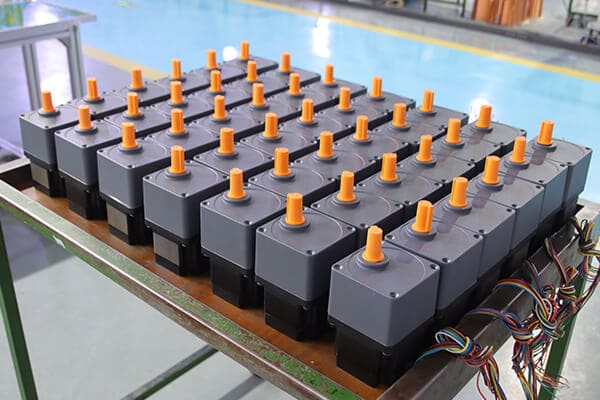
Geared Brushless DC (BLDC) motors are a combination of two powerful technologies — the brushless DC motor and a mechanical gearbox. Together, they deliver precise speed control, high torque output, and exceptional energy efficiency, making them essential components in automation, robotics, electric vehicles, and industrial machinery.
To understand how a geared BLDC motor works, it's important to break down both its mechanical and electrical principles and explore how they function together as one seamless, efficient motion system.
1. Overview of a BLDC Motor
A Brushless DC motor (BLDC) operates on direct current (DC) power and uses electronic commutation instead of traditional brushes. It consists of a stator (stationary part) containing windings and a rotor (rotating part) that carries permanent magnets.
Unlike brushed motors that rely on mechanical brushes to switch current flow, a BLDC motor uses electronic controllers and sensors to determine the rotor's position and control the flow of current in the stator coils.
Key Components of a BLDC Motor
Stator: Contains copper windings energized in sequence to produce a rotating magnetic field.
Rotor: Houses permanent magnets that follow the stator's magnetic field.
Hall Sensors (or Encoders): Detect the rotor's position and send feedback to the controller.
Electronic Controller (Driver): Switches current in the correct sequence to control speed and torque.
This setup allows for precise speed regulation, smooth operation, and higher efficiency compared to brushed motors.
2. The Role of the Gearbox
While BLDC motors are efficient and responsive, they typically rotate at high speeds with relatively low torque. To make them suitable for applications requiring high torque and low speed, a gearbox is attached to the motor shaft.
How the Gearbox Works
The gearbox consists of a series of gears that reduce the motor's rotational speed while increasing its torque output proportionally.
Input Shaft: Connected to the BLDC motor's rotor.
Gear Train: Transmits and multiplies torque through mechanical gear reduction.
Output Shaft: Delivers the adjusted torque and speed to the load.
For example, if a BLDC motor rotates at 3000 RPM with a gear ratio of 30:1, the gearbox will reduce the output speed to 100 RPM but increase the torque approximately 30 times (minus minor efficiency losses).
This process transforms a high-speed, low-torque motor into a low-speed, high-torque drive system, ideal for powering heavy machinery or precision equipment.
When a geared BLDC motor operates, electrical and mechanical systems work together in perfect synchronization. Here's a step-by-step breakdown of how it functions:
Step 1: Power Supply and Signal Processing
DC power from a battery or DC source is sent to the electronic controller. The controller processes input signals such as speed command or torque requirement.
Step 2: Electronic Commutation
Based on rotor position feedback (from Hall sensors or encoders), the controller switches current through the stator windings in a specific sequence.
This creates a rotating magnetic field that pulls the rotor magnets into motion — thus producing rotation.
Step 3: Torque Generation
As the magnetic field continuously rotates, the rotor spins at high speed. The torque produced is transmitted to the gearbox input shaft.
Step 4: Gear Reduction
Inside the gearbox, gears mesh together to convert the motor's high-speed rotation into slow, high-torque output. The specific gear ratio determines how much the speed is reduced and torque is multiplied.
Step 5: Output Delivery
Finally, the output shaft of the gearbox delivers smooth, controlled, and powerful motion to drive mechanical loads — such as conveyor belts, robotic joints, or vehicle wheels.
This combination allows the geared BLDC motor to perform efficiently across variable loads and speeds, maintaining stable torque and high precision.
4. Gearbox Types Used in BLDC Motors
Different applications require specific gearbox designs to optimize performance, durability, and efficiency.
a. Planetary Gearbox
Structure: Features planet gears orbiting around a central sun gear within a ring gear.
Advantages: High torque density, compact design, low backlash, and excellent load distribution.
Applications: Robotics, automation, electric vehicles, and aerospace systems.
b. Spur Gearbox
Structure: Consists of parallel gears with straight teeth.
Advantages: Simple construction, high efficiency, and cost-effectiveness.
Applications: Printing machinery, office automation, and low-noise systems.
c. Worm Gearbox
Structure: A screw-shaped worm meshes with a toothed worm wheel.
Advantages: High reduction ratios, self-locking capability, and quiet operation.
Applications: Lifts, hoists, gates, and heavy-load handling systems.
Each gearbox type offers unique performance benefits depending on the application's torque, speed, and space constraints.
5. Control Mechanism and Feedback Loop
The controller plays a central role in how a geared BLDC motor operates. It continuously monitors speed, torque, and rotor position to maintain stability under varying loads.
Control Methods Include:
Speed Control: Adjusting the input voltage or PWM (Pulse Width Modulation) signal to regulate speed.
Torque Control: Managing current flow to deliver consistent torque output.
Position Control: Using encoders for closed-loop feedback in servo applications.
The feedback loop ensures that the motor maintains desired performance accuracy, compensating for load variations and mechanical resistance automatically.
6. Performance Characteristics
The integration of a gearbox with a BLDC motor enhances performance across multiple parameters:
| Parameter | Effect of Gearbox Integration |
| Torque | Significantly increased |
| Speed | Proportionally reduced |
| Efficiency | Maintained with minimal losses |
| Control Accuracy | Greatly improved |
| Durability | Extended operational life |
These attributes make geared BLDC motors ideal for applications requiring precise motion control, high torque, and long service life.
7. Example of Operation in Real Applications
To illustrate how geared BLDC motors work in practice, let's consider a few examples:
In a Robotic Arm:
The geared BLDC motor in each joint allows fine control of movement and positioning. The gearbox provides torque for lifting loads while maintaining smooth rotation for accurate motion paths.
In an Electric Vehicle:
The motor's high-speed output is reduced by a gearbox to produce torque that drives the wheels efficiently, enabling acceleration and hill-climbing capability.
In a Conveyor System:
The geared BLDC motor delivers consistent, controllable motion, allowing variable speed operation with high torque for transporting goods smoothly.
In all these examples, the core principle remains the same — high-speed electrical rotation is converted into controlled mechanical motion with the help of gear reduction.
Conclusion
A Geared BLDC Motor operates through the seamless interaction between electronic commutation and mechanical gear reduction. The BLDC motor provides efficient, brushless electrical motion, while the gearbox multiplies torque and reduces speed for controlled mechanical output. Together, they deliver unmatched precision, efficiency, and durability — powering everything from robots and EVs to automation equipment and medical devices.
Understanding how geared BLDC motors work is key to unlocking their potential in modern engineering applications where power, control, and reliability are essential.


