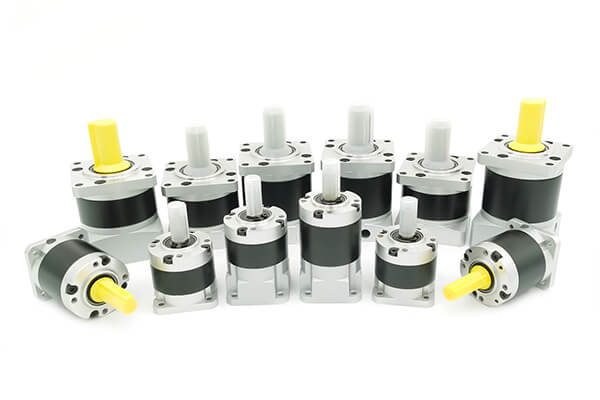
Understanding Backlash in a Planetary Gearbox
A Planetary Gearbox is widely used in automation systems, robotics, CNC machines, and precision motion control equipment due to its high torque density, compact design, and excellent load distribution. However, one important characteristic that engineers and system designers must understand is backlash.
Backlash refers to the small amount of rotational play or clearance between mating gear teeth inside a gearbox. In simple terms, it is the slight movement that occurs when the direction of rotation changes before the gears fully engage again. This clearance exists between the sun gear, planet gears, and ring gear inside the planetary gear system.
Every mechanical gear system requires some level of backlash to ensure smooth operation, lubrication flow, and thermal expansion compensation. Without this clearance, gears would bind, overheat, and wear prematurely. Therefore, the presence of backlash is not necessarily a defect; it is a designed mechanical tolerance.
In planetary gearboxes, backlash is typically much smaller than in conventional gear systems, which is one of the key reasons they are preferred for high-precision motion applications.
")
A planetary gearbox consists of three main gear components:
Sun Gear – the central gear connected to the motor shaft
Planet Gears – multiple gears that rotate around the sun gear
Ring Gear – the outer gear that holds the planetary set together
When torque is transmitted through this system, gear teeth must have a small gap between them. This gap prevents excessive friction and allows for proper lubrication film formation.
Backlash occurs during directional changes. For example:
The motor rotates clockwise.
The gear teeth engage in that direction.
When rotation switches to counterclockwise, the teeth must travel across the clearance gap before engaging again.
This tiny delay in engagement is what we call gear backlash.
In a planetary gearbox, this effect is minimized because multiple planet gears share the load simultaneously, which improves gear engagement and reduces rotational play.
Typical Backlash Values in Planetary Gearboxes
The amount of backlash depends on gear manufacturing precision, gearbox design, and application requirements.
Typical backlash ranges include:
| Gearbox Type | Typical Backlash |
| Standard Planetary Gearbox | 8–15 arcminutes |
| Precision Planetary Gearbox | 3–8 arcminutes |
| Ultra-Precision Planetary Gearbox | 1–3 arcminutes |
High-precision motion systems such as robotics, semiconductor equipment, and CNC machines require very low backlash gearboxes to maintain positioning accuracy.
Many advanced planetary gearboxes are designed with optimized tooth geometry, preload mechanisms, and high-precision machining to significantly reduce backlash.
Why Planetary Gearboxes Have Lower Backlash Than Other Gear Types
A Planetary Gearbox is widely recognized for delivering high precision, compact structure, and low backlash performance compared with many traditional gear transmission systems. In industrial automation, robotics, CNC machinery, and motion control systems, backlash reduction is critical for maintaining positioning accuracy and smooth torque transmission. Planetary gearboxes naturally achieve lower backlash because of their unique gear arrangement, balanced load distribution, and precision engineering design.
Below are the key mechanical reasons why planetary gearboxes provide significantly lower backlash than other gearbox types.
1. Multiple Planet Gears Share the Load Simultaneously
One of the most important structural advantages of a planetary gearbox is the presence of multiple planet gears engaged at the same time.
In a planetary gear system, torque is transmitted through:
Sun gear
Multiple planet gears
Ring gear
Unlike traditional gearboxes that rely on a single pair of gears, planetary gear systems typically use three or more planet gears positioned evenly around the sun gear. Because several gears are engaged simultaneously, the clearance between gear teeth is effectively distributed across multiple contact points.
This design creates:
As a result, backlash is naturally minimized within the planetary gear structure.
2. Symmetrical Gear Distribution Improves Engagement Accuracy
Planetary gearboxes feature a perfectly symmetrical gear layout. The planet gears are evenly spaced around the central sun gear and rotate inside a fixed ring gear.
This symmetrical structure provides several mechanical benefits:
Because the load is distributed equally across all gears, tooth engagement remains stable during operation, which reduces gaps between gear contacts. This contributes to lower backlash compared to asymmetric gear systems such as spur gear reducers.
3. Coaxial Input and Output Design Reduces Mechanical Play
Another key advantage of a Planetary Gearbox is its coaxial design, where the input shaft and output shaft share the same centerline.
This alignment provides important benefits:
In contrast, gear systems with offset shafts or multiple transmission stages often introduce additional mechanical clearances that increase backlash. The compact coaxial arrangement of planetary gearboxes keeps gear engagement tighter and more precise.
4. Short Torque Transmission Path
Planetary gearboxes have a very compact internal gear train. The torque travels through a short and direct path from the input shaft to the output carrier.
Because the torque path is short:
There are fewer components involved in power transmission
Less accumulated clearance between mechanical elements
Reduced opportunities for rotational slack
This compact structure plays a major role in achieving low backlash and high positional accuracy.
5. High Precision Gear Manufacturing
Modern planetary gearboxes are produced using advanced gear machining technologies, such as:
These manufacturing processes create highly accurate gear tooth profiles with extremely tight tolerances.
Precision gears ensure:
In high-end planetary gearboxes, backlash can be reduced to as low as 1–3 arcminutes, which is significantly lower than many conventional gear reducers.
6. Load Distribution Reduces Gear Wear Over Time
Backlash in gear systems often increases over time due to gear tooth wear. Planetary gearboxes reduce this problem because the load is shared among multiple planet gears.
This results in:
Because the gears wear more slowly and evenly, planetary gearboxes can maintain low backlash performance for a longer service life.
7. Advanced Preload and Anti-Backlash Design Options
Many precision planetary gearboxes incorporate special engineering features designed to further minimize backlash.
Examples include:
These design improvements ensure that gear teeth remain tightly engaged during directional changes, significantly reducing rotational play.
8. Strong Structural Rigidity
Planetary gearboxes are designed with high structural rigidity, which helps maintain precise gear alignment even under heavy loads.
Rigid housing structures prevent:
Maintaining proper alignment ensures consistent gear contact, which directly contributes to lower backlash and smoother motion control.
Comparison With Other Gearbox Types
Compared with other common gearbox designs, planetary gearboxes generally provide superior backlash performance.
| Gearbox Type | Backlash Level | Reason |
| Planetary Gearbox | Low | Multiple gear engagement |
| Spur Gearbox | Medium | Single gear pair contact |
| Worm Gearbox | High | Sliding contact and larger clearances |
| Helical Gearbox | Medium | Improved contact but fewer load paths |
Because of these characteristics, planetary gearboxes are widely preferred for precision automation and servo-driven systems.
Summary
Planetary gearboxes achieve lower backlash than most other gear types due to their unique mechanical design and precision engineering. Key advantages include:
Multiple planet gears sharing the load
Symmetrical gear engagement
Coaxial shaft alignment
Compact torque transmission path
High-precision manufacturing
Long-term wear resistance
These features allow planetary gearboxes to deliver excellent positioning accuracy, smooth torque transfer, and reliable performance in demanding applications such as robotics, CNC machines, semiconductor equipment, and industrial automation systems.
For applications that require high precision motion control and minimal rotational play, a low-backlash planetary gearbox remains one of the most effective and widely adopted gearbox solutions in modern engineering.
Does Backlash Affect Performance?
Backlash can affect performance in certain applications, especially those that require precise positioning and repeated direction changes.
Potential effects include:
However, in most industrial automation systems, controlled backlash is completely acceptable and often necessary for durability and efficiency.
In fact, removing backlash entirely would create excessive friction and gear wear, which would reduce the lifespan of the gearbox.
Therefore, the goal in gearbox design is not to eliminate backlash but to minimize and control it.
A Planetary Gearbox with low backlash is essential in many modern motion control systems where precision positioning, repeatability, and smooth directional changes are critical. Backlash refers to the small clearance between gear teeth during transmission, and minimizing it allows machines to achieve higher accuracy, faster response, and better stability.
Low backlash planetary gearboxes are widely used in industries where micron-level positioning accuracy and high dynamic performance are required. Below are the most common applications where low backlash planetary gearboxes play a crucial role.
1. Industrial Robotics
Industrial robots require extremely precise motion control to perform tasks such as assembly, welding, packaging, and material handling. Robotic joints frequently change direction and must maintain accurate positioning during complex movements.
Low backlash planetary gearboxes are ideal for robotic systems because they provide:
In robotic arms, even a small amount of backlash can cause positioning errors or vibration, which may affect production quality. Therefore, precision robotic systems commonly integrate servo motors combined with low backlash planetary gear reducers.
2. CNC Machine Tools
Computer Numerical Control (CNC) machines depend on highly accurate linear and rotary motion to manufacture precision parts. Components such as lead screws, ball screws, and rotary axes often rely on planetary gearboxes for torque amplification.
Low backlash gearboxes are necessary in CNC equipment because they ensure:
If backlash is too large, the machine may experience tool path deviation, which directly affects dimensional accuracy and surface finish of machined components.
3. Semiconductor Manufacturing Equipment
The semiconductor industry requires ultra-high precision automation systems for processes such as wafer handling, lithography, and chip inspection.
Machines used in semiconductor fabrication operate at micron or even nanometer-level accuracy, meaning mechanical transmission components must deliver extremely low backlash performance.
Low backlash planetary gearboxes help semiconductor equipment achieve:
High precision wafer positioning
Stable motion during high-speed operations
Reduced vibration and mechanical error
These gearboxes are commonly used in wafer transfer robots, alignment stages, and automated inspection systems.
4. Automated Packaging Machinery
Modern packaging lines rely on high-speed synchronized motion to perform tasks such as filling, labeling, sealing, and product sorting.
Packaging machines often require frequent start-stop movements and rapid direction changes, which makes low backlash gear systems critical.
A Planetary Gearbox with minimal backlash allows packaging equipment to maintain:
Precise product positioning
Accurate label placement
Smooth conveyor synchronization
High-speed production efficiency
Without low backlash transmission, packaging systems may suffer from misalignment, inconsistent product placement, or mechanical vibration.
5. Medical and Surgical Equipment
Medical devices often require highly controlled motion systems to ensure safe and reliable operation. In applications such as surgical robots, imaging systems, and laboratory automation, precise mechanical transmission is essential.
Low backlash planetary gearboxes are used in medical equipment because they offer:
High motion accuracy
Quiet and smooth operation
Reliable long-term performance
Stable micro-movement control
For example, surgical robotic systems must perform precise instrument movements, and any backlash could reduce the surgeon’s control accuracy.
6. Aerospace and Satellite Systems
In aerospace engineering, motion control components must meet extremely strict precision, reliability, and durability requirements.
Low backlash planetary gearboxes are used in applications such as:
Satellite antenna positioning systems
Aircraft control mechanisms
Space robotics and exploration devices
These systems demand precise angular positioning and stable torque transmission, even under harsh environmental conditions.
Planetary gearboxes provide the compact design and high torque density needed for aerospace applications while maintaining minimal backlash.
7. Automated Guided Vehicles (AGV) and Mobile Robots
Autonomous mobile robots and automated guided vehicles rely on precise drivetrain systems to navigate accurately in warehouses and production facilities.
Low backlash planetary gearboxes help AGV systems achieve:
In robotic mobility platforms, even small mechanical delays can lead to navigation errors or inefficient movement, making low backlash gear transmission critical.
8. Printing and Labeling Machines
High-speed printing equipment requires extremely precise synchronization between rollers, feeding systems, and printing heads.
Low backlash planetary gearboxes ensure:
Precise paper or film positioning
Consistent printing alignment
Reduced vibration at high speed
Maintaining precise motion control is essential to ensure clear print quality and accurate label placement.
9. Laser Cutting and Engraving Machines
Laser cutting and engraving machines require highly accurate positioning systems to control the laser beam path.
Low backlash planetary gearboxes help achieve:
Backlash in the motion system could cause cutting deviations or irregular patterns, which negatively affects product quality.
10. Automated Assembly Lines
Automated assembly systems often involve robotic pick-and-place units, positioning platforms, and conveyor synchronization systems.
Low backlash planetary gearboxes enable assembly machines to maintain:
Precise component placement
High-speed repetitive motion
Stable mechanical alignment
These systems require consistent repeatability to ensure that components are assembled accurately during mass production.
Conclusion
Low backlash Planetary Gearbox systems are essential for industries that demand high precision, smooth motion control, and accurate positioning. Their compact structure, balanced load distribution, and precision gear design make them ideal for advanced automation systems.
Applications that rely heavily on low backlash planetary gearboxes include:
As industrial automation continues to evolve, the demand for high-precision, low backlash planetary gearboxes will continue to grow, supporting the development of smarter, faster, and more accurate motion control technologies.
How Engineers Reduce Backlash in Planetary Gearboxes
A Planetary Gearbox is widely used in high-precision motion systems because it naturally provides low backlash and high torque density. However, for applications such as robotics, CNC machining, semiconductor equipment, and automation systems, engineers must further reduce backlash to extremely small levels to ensure precise positioning and smooth motion control.
Backlash cannot be completely eliminated because a small clearance between gear teeth is necessary for lubrication, thermal expansion, and smooth operation. Instead, engineers focus on minimizing and controlling backlash through advanced design, precision manufacturing, and optimized assembly techniques.
Below are the most important engineering methods used to reduce backlash in planetary gearboxes.
1. Precision Gear Tooth Grinding
One of the most effective ways to reduce backlash is through high-precision gear manufacturing.
Modern planetary gears are produced using advanced processes such as:
CNC gear hobbing
Gear shaping
Precision gear grinding
Super-finishing
Gear grinding is particularly important because it produces extremely accurate tooth profiles and smooth contact surfaces. When gear teeth are manufactured with tight tolerances and precise geometry, the clearance between meshing gears is significantly reduced.
This ensures:
High-precision gear grinding is commonly used in servo planetary gearboxes and high-performance motion control systems.
2. Preloaded Gear Designs
Another common engineering solution is the use of preload mechanisms inside the gearbox.
Preloading applies a controlled force that pushes gear teeth into constant contact, minimizing the gap that causes backlash. This can be achieved through several design methods:
With preload applied, the gear teeth remain tightly engaged during directional changes, which reduces the delay before torque transmission resumes.
This approach is particularly effective in precision servo applications where frequent reversing motion occurs.
3. Dual Planet Gear Systems
Some high-precision planetary gearboxes incorporate dual planet gear configurations. In this design, two gears are mounted on the same planet carrier and preloaded against each other.
The benefits of this configuration include:
Elimination of gear tooth clearance
Improved contact stability
Reduced vibration during direction changes
Dual planet gear systems are often used in high-end automation equipment and precision robotics, where extremely low backlash is required.
4. Optimized Gear Tooth Geometry
Gear tooth design plays a crucial role in backlash reduction. Engineers use advanced tooth profile optimization techniques to improve gear engagement.
Key design improvements include:
By carefully designing the tooth shape and contact area, engineers can ensure that gears mesh more tightly and evenly, reducing unnecessary clearance between teeth.
This optimized geometry also improves load distribution and reduces mechanical noise.
5. High-Precision Bearings
Backlash is not only influenced by gear teeth; it can also be affected by shaft movement and bearing clearance.
To minimize this effect, engineers use high-precision bearings, such as:
These bearings help maintain stable shaft positioning and minimal radial movement, ensuring that gear teeth remain properly aligned during operation.
Stable shaft alignment directly contributes to lower backlash and smoother rotation.
6. Tight Assembly Tolerances
Even with perfectly manufactured gears, improper assembly can introduce unwanted backlash. Therefore, strict assembly tolerances and alignment procedures are essential.
During gearbox assembly, engineers carefully control:
Gear spacing
Bearing preload
Shaft alignment
Carrier positioning
Precision measurement tools such as laser alignment systems and coordinate measuring machines (CMM) are often used to verify gearbox accuracy.
Maintaining tight assembly tolerances ensures that the designed backlash specification is consistently achieved.
7. High-Rigidity Housing Design
The gearbox housing must provide strong structural support to maintain accurate gear alignment under load.
If the housing flexes or deforms during operation, the gear alignment may shift, which increases backlash.
To prevent this, engineers design housings with:
A rigid housing structure ensures that gear positions remain stable even under heavy torque loads, helping maintain low backlash throughout the gearbox lifespan.
8. Multiple Planet Gear Engagement
One inherent advantage of the Planetary Gearbox design is the use of multiple planet gears sharing the load simultaneously.
Typically, planetary gearboxes include three or more planet gears evenly distributed around the sun gear. This multi-point engagement provides:
Balanced load distribution
Reduced individual gear clearance
Improved rotational stability
Because several gears are engaged at once, the system naturally experiences less rotational play compared to single gear pair transmissions.
This structural feature is one of the primary reasons planetary gearboxes already have lower backlash than many other gearbox types.
9. Advanced Surface Treatments
Gear durability and backlash stability can also be improved through advanced surface treatments and heat treatment processes.
Common treatments include:
Carburizing
Nitriding
Induction hardening
These treatments increase surface hardness and wear resistance, which helps gears maintain their original shape and dimensions over long periods of operation.
By preventing premature wear, these treatments help ensure that backlash does not increase significantly over time.
Conclusion
Reducing backlash in a Planetary Gearbox requires a combination of precision engineering, advanced manufacturing techniques, and optimized mechanical design.
Engineers achieve low backlash performance through:
Precision gear grinding
Preloaded gear mechanisms
Dual planet gear systems
Optimized gear tooth geometry
High-precision bearings
Strict assembly tolerances
Rigid housing structures
Multi-planet gear engagement
Advanced surface treatments
By integrating these engineering solutions, modern planetary gearboxes can achieve extremely low backlash levels while maintaining durability, efficiency, and smooth torque transmission.
This makes planetary gearboxes the preferred choice for high-precision applications such as robotics, CNC machinery, semiconductor manufacturing, and advanced automation systems where accurate motion control is essential.
Planetary Gearbox vs Other Gearboxes in Terms of Backlash
When comparing different gearbox types, planetary gear systems consistently offer better precision and lower backlash.
| Gearbox Type | Backlash Level | Precision |
| Planetary Gearbox | Low | Very High |
| Spur Gearbox | Medium | Moderate |
| Worm Gearbox | High | Lower |
| Helical Gearbox | Medium | High |
Because of this advantage, planetary gearboxes are widely used in precision automation and servo motor systems.
Selecting the right planetary gearbox requires evaluating several key parameters:
Backlash Specification
Choose a gearbox with a backlash rating suitable for your application, such as ≤5 arcminutes for precision motion systems.
Gear Ratio
Planetary gearboxes offer ratios ranging from 3:1 to over 100:1, depending on the number of gear stages.
Torque Capacity
Ensure the gearbox can handle the maximum required torque without excessive wear.
Motor Compatibility
The gearbox should match the motor shaft size, mounting interface, and operating speed.
Application Environment
Consider factors such as:
A properly selected planetary gearbox ensures high performance, long service life, and accurate motion control.
Conclusion: Planetary Gearboxes Do Have Backlash — But It Is Precisely Controlled
All gear systems, including planetary gearboxes, have some degree of backlash. This small clearance between gear teeth is necessary for lubrication, thermal expansion, and smooth operation.
However, thanks to advanced design, multiple gear engagement, and precision manufacturing, planetary gearboxes maintain significantly lower backlash compared to traditional gear systems.
This controlled backlash allows planetary gearboxes to deliver:
High positional accuracy
Smooth torque transmission
Excellent load distribution
Reliable long-term performance
For applications requiring high-precision motion control, a low-backlash planetary gearbox remains one of the most efficient and reliable mechanical solutions available in modern automation systems.
In summary, planetary gearboxes do have backlash, but through precision engineering and optimized gear design, it is minimized to ensure superior motion accuracy, durability, and performance in demanding industrial applications.


